A second round of tablet computer tests is underway at boot camp. testing tablet computers Experiments with tablet computers at Boot Camp continued August 13, as 87 more recruits were issued off the shelf Windows tablets in what officials are calling the "second cycle" of the "pre-pilot" phase of tablet testing.
In mid-August, recruits at Recruit Training Command Great Lakes, Illinois, were temporarily issued Windows-compatible electronic tablets to see how effective and durable these devices are, as the Navy continues its journey to catch up to the smart device revolution that puts communications and knowledge only a few thumb taps away.
The goal of the "eSailor" initiative is to eventually adopt a idea behind the tests and the possible impact is huge — the possibility of putting a smart device or tablet computer that can be in every sailor’s hands, issued to sailors at boot camp as part of their seabag and will then accompany them through "A" schools and to the fleet.
In all, Three such small scale "pre-pilot" tests of 200 or less tablets are planned this year. The goal is to set the stage for early next calendar year, when officials will expand into a full pilot tests, where as many with as many as 1,500 recruits test the devices during boot camp. being issued tablets during training.
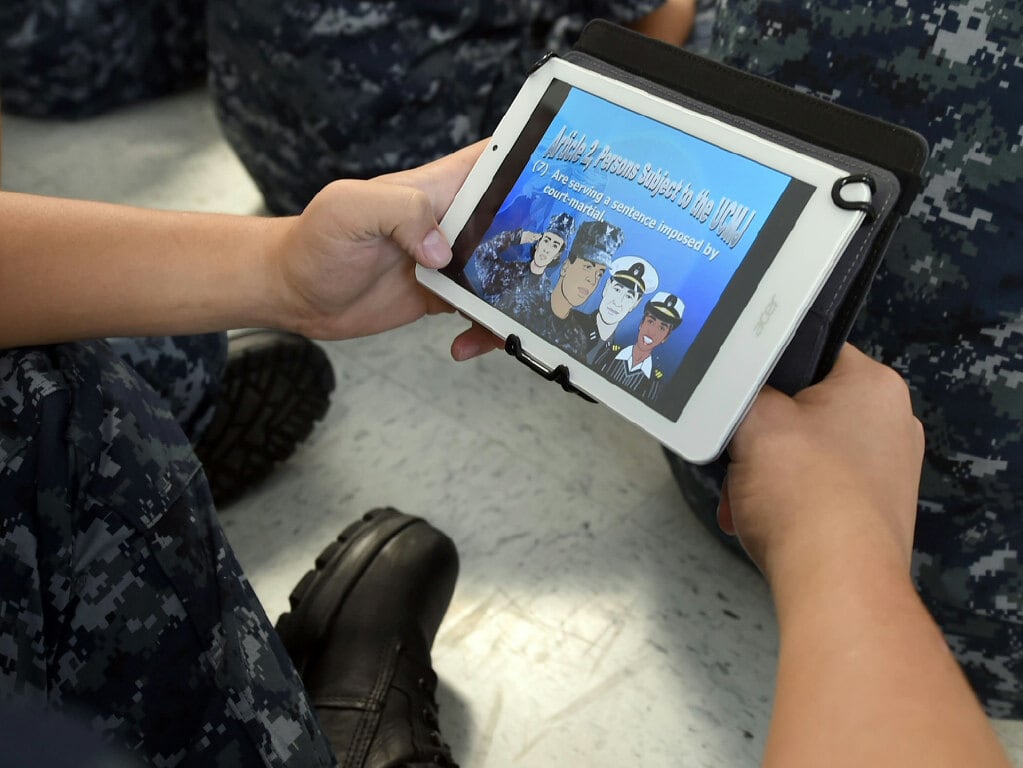
The first cycle of tests wereas conducted in April and May, with 134 "off the shelf" Acer Iconia 8 tablets used being tested by recruits and recruit division commanders as study and teaching aids.
"What is significant for the initiative is that as we progress through the pre-pilot and fine tune our processes, it allows us to better manage the larger scale pilot, which will be expanded to an entire ship at RTC," said Lt.T Sean Brophy, spokesman for Naval Service Training Command, which overseas nearly all of the Navy's accession training in the Navy except the Naval Academy.
The tests in using tablets in training are only happening, at Recruit Training Command, for now.
"There are no current plans to expand eSailor to other naval accessions training programs," Brophy said. "However, the pilot program at Recruit Training Command will allow us to evaluate the efficacy of future expansion."
Sailors aren't going to be taking any issued tablets from boot camp anytime soon. These experimental pilots are using the same devices and will be returning them at the end of boot camp training. Next year, the number of different tablets will grow as the size of the recruit testing grows. But during the tests, now and in the near future the tablets are being issued for the Great Lakes tests only and won’t leave with recruits. In fact, the tablets being use in all three planned phases of the "pre-pilot" are the exact same devices. Next year, when the numbers and scope expand — so will types of tablets and operating systems expand.
The idea was the brainchild of Master Chief Petty Officer of the Navy (AW/NAC) Mike Stevens and the multiple sources tell Navy Times thatincoming chief of naval operations, Adm. John Richardson, is a huge fan. Sources said they expect these tests to gradually expand as the Navy looks for a suitable device that has the communications, storage capacity, durability and security features needed to survive fleet duty. of the idea as well, so look for these tests to continue and if deemed feasible — gradually expand, sources tell Navy Times.
Initial Impressions and Lessons Learned
The first trial in April assessed the logistics of issuing and maintaining e-tablets, with follow-on tests looking to refine the user experience. The new test aims to repeat the first one, albeit with half as many sailors though they are also trying to begin to refine the user experience of using the tablets in learning how to be a sailor. The new pre-pilot comes after officials finished compiling data from the April’s text of 134 recruits using the Acer Iconia tablets for the duration of their boot camp experience. Essentially this second test is a repeat of of the first, though with fewer numbers — one division of recruits instead of the two divisions used in April.
"These first tests are really a test of concept," said John Drake, head of NSTC's Navaly Service Training Command’s strategy and analysis division, which is overseeing the tests. So primarily they are looking at the logistics of issuing and maintaining tablets, though they are also trying to begin to refine the user experience of using the tablets in learning how to be a sailor.
"We're still in the pre-pilot phase," Drake said. "The pre-pilot will consist of three cycles of testing and we've completed the first and will use some of the lesson's learned to change slightly what we are doing in the second."
During the first cycle, recruits and RDC’s were surveyed four times — first when they were issued the devices; twice during training; and once at the end, Drake said. That same survey schedule will carry over into both follow-on cycles of the pre-pilot. The idea is to gradually improveexpand the user experience, he said, while also working out the logistics of how recruits carry, stow and care for their devices, too.
To see how "sailor proof" the devices are, Drake said some of the test devices were issued without protective covers that can prevent damage when dropped. Navy went out on a limb during the first tests and issuing many of the tablets with no protective covers to helped prevent damage when dropped. This was deliberate, Drake said, to see how "sailor proof" that off the shelf devices have.
Drake said nearly half of the 134 tablets issues were damaged. "During the process of the first cycle, of the 134 tablets we handed out to recruits," Drake said. "Of those, 63 tablets experienced some type of damage." he said.
"Fifty-four of those had what we would call minor damage, such as cracked screens, but they were still operable, while nine had severe damage and were no longer usable," Drake said.
The majority of those damaged lacked, were those that didn’t have protective cases.
"Obviously, we'll be using protective covers from now on," he said. "I think we got that one, but it helped to understand how that was happening."
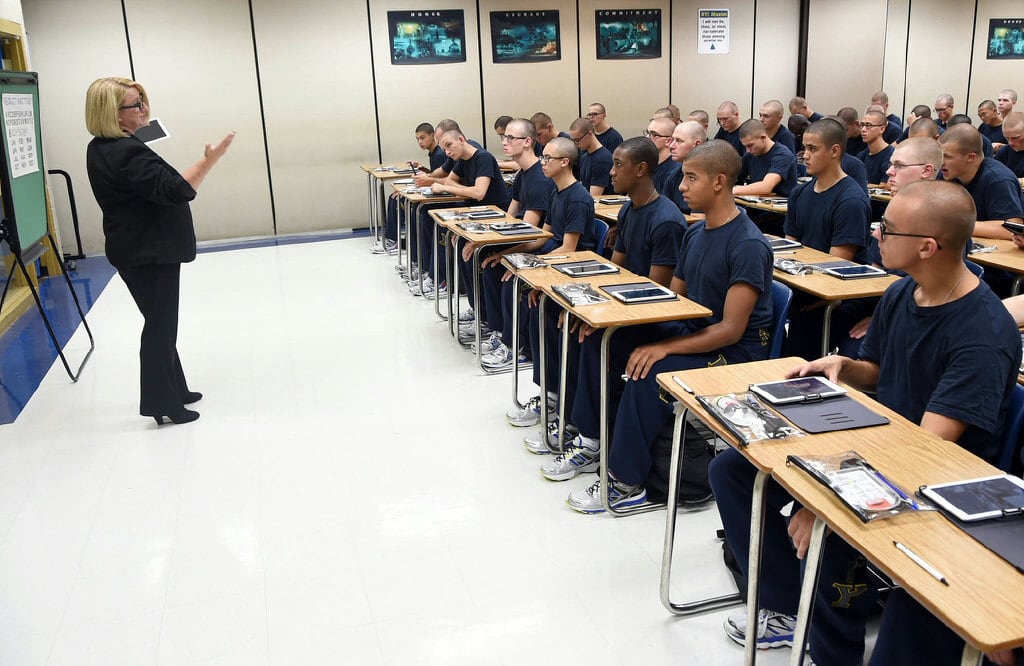
Patricia Moore, N5 Education Research Analyst for Naval Service Training Command (NSTC), introduces new recruits to electronic tablets on Aug. 13 at Recruit Training Command at Great Lakes, Ill.
Photo Credit: Scott A. Thornbloom/Navy
Instead of yelling at recruits when devices are damaged, recruits are asked to detail exactly how the accident happened — feedback that has led officials to adjust where and when recruits take their tablets. As a result, Drake said officials are adjusting the rules on how, where and when recruits will carry and stow their tablets.
For example, he said, many devices were damaged from falling off sailors bunks. That's no longer allowed. , so from now on, that won’t be allowed. Another logistic discovery was that high-capacity charges were needed to get the devices a full charge amid recruits' hectic schedules. while charging the devices. The original charging stations were too slow, so high-capacity charging stations will now be used to speed the process along.
Overall, recruits had a positive experience. Roughly 4 out of 5 said the tablets were said the tablets were Also surveyed were impressions on using the device and the impact on training. Feedback fro the recruits was highly positive with 79 percent saying using tablets was "extremely beneficial" to their boot camp training, with about the 83 percent saying they were "extremely satisfied." . Eighty-three percent of the recruits were "extremely satisfied" with how the tablets performed while 92 percent were happy with the content placed on the devices.
Instructional videos that show newbies basics like making their rack boosted recruits' performance, the survey found. One of the discoveries that came from recruits using tablets was the impact access to training videos had on recruits performance with 67 percent of the recruit division commanders stating that recruit performance was significantly higher on those topics.
"Videos had been placed on the tablets showing recruits how to fold their clothes and how to stow their gear and make their bunks," Drake said. "It’s the kind of stuff that the RDC’s sometimes have to reiterate over and over, so they felt in an informal way that these recruits performed better in those areas than recruits they’d had who didn’t have that video content to use."
And in fact, recruits want even more videos and apps on an expanded range of topics, Drake said. Already Apps are in the works to help sailors learn to recognize ships and aircraft as well as ranks and ratings. Some other topics requested for videos and apps are firefighting and damage control, marlinspike seamanship — even how to shine their boots. They are also looking at providing all the 21st Century Sailor apps on the tablets as well.
In addition, Drake said, that recruits also asked for more reference material to allow more study on topics they're learning in class.
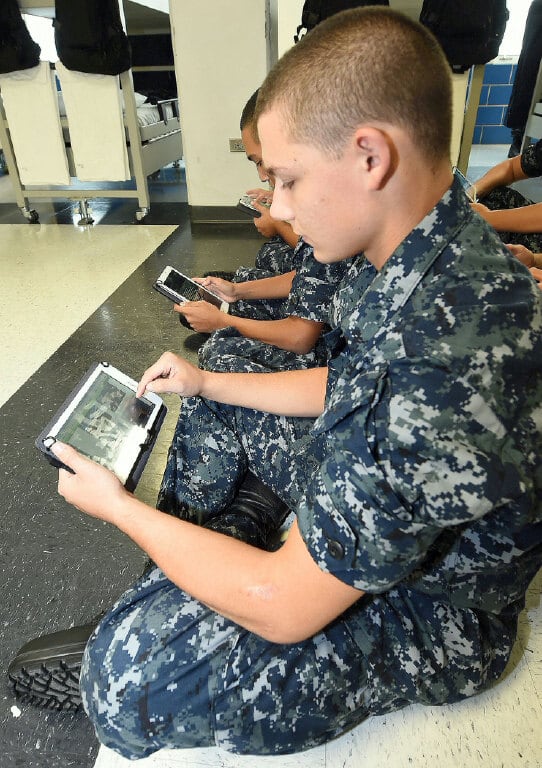
Seaman Recruit Donald Shrupp, 18, uses an electronic tablet (e-tablet) during a study period in his barracks, USS Hopper, at Recruit Training Command. The second cycle of testing will help determine how well the device integrates into the training environment at RTC. The e-tablets contain RTC curriculum, including training videos, texts and access to professional development websites.
Photo Credit: Scott A. Thornbloom/Navy
When MCPON Stevens has said he'd like to see recruits use the e-tablets to stay in touch with their families. One of the sticking points has been internet connections. introduced the idea, he felt it would be good for recruits to use email to communicate with home. And having an internet connection was one of the sticking points that prevented the pre-pilot from beginning sooner. Drake says there is a Navy mobility study group that is investigating how the service will provide wi-fi through government servers. Bypassing Navy bandwidth, RTC is using a commercial solution — mobile hot spots. There is also a Navy group studying ways to provide Wi-Fi. These that can be brought out by RDC’s at appropriate times and provide a 4G wireless broad band commercial signal.
"After week four of training, recruits have the ability, during holiday routine hours, to send and receive email," Drake said. "This solution works well and we plan to continue it during the next two cycles." Recruits do not have access to the open internet, however. Next year, testing will expand to 1,500 recruits, about a fourth of the total recruit population at a given time.
But the real fun will start early next calendar year, Drake said, when the tests will greatly increase in scale as the Navy moves into the actual pilot program.
The plan is to issue an entire "ship" as barracks are called at Recruit Training Command one of three different types tablets, about 1,500 total recruits which actually amounts to 20 to 30 percent of the recruit population, which fluctuates between 5 and 8,000 at any given time.
"The pilot will be an 18-24 month effort," Drake said. "It will begin early next year. During that time, we'll be evaluating tablets across all three operating systems, windows, [Apple] IOS and Android."
Gradually, RTC will expand the variety and scope of the training content, too and are working with Navy and commercial partners to provide them, based on the Navy's needs.
In addition, Drake said, both Apple and Microsoft are working with the Navy to help customize the user interface and experience of the tablets to the Navy’s needs, too, though he didn’t give any examples.
But it will be these tests which ultimately determine whether the service will decide to issue a tablet or smart device to every sailor entering the Navy.
Follow on tests, possibly done in parallel in the next few years are being discussed to test out tablets and smart devices at "A" schools around the Navy — mostly likely starting at schools already at Great Lakes, sources tell Navy Times. In addition, the Navy’s mobility working group will continue to decide how the service can provide wi-fi to both sea and shore units around the service.
"Once they decide how we're supposed to do it," Drake said, "we'll implement it."
Mark D. Faram is a former reporter for Navy Times. He was a senior writer covering personnel, cultural and historical issues. A nine-year active duty Navy veteran, Faram served from 1978 to 1987 as a Navy Diver and photographer.