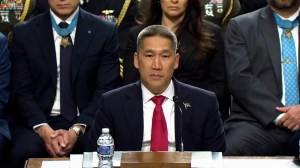
Many troops early in their careers just don’t want to listen to financial advice. They don’t want to hear about major changes or even tweaks that could relieve stress now and make the future brighter.
So when Air Force Chief Master Sgt. Jeffrey Kahapea volunteered for a financial review through Military Times, he also saw an opportunity to help younger troops.
Kahapea is one of four service members who volunteered for this year’s special report on Troops And Their Money. Military Times put out a call for troops to have their finances reviewed by financial professionals. A variety of service members of different ranks, and in different financial circumstances, responded.
Kahapea wished he had worked with an adviser earlier in his career – and he wants other troops to start getting serious about their finances early.
While he and his wife, Belinda, have done pretty well, there are things they could have done earlier, he said, that would have made their financial situation much better today. He sought financial advice about 10 years ago, but didn’t follow all of it.
“The advice they gave me I was not ready for,” he said, especially related to key elements that have come into play for him personally, such as life insurance.
With retirement about a year away, he’s been plugging in the gaps to ensure he and Belinda can go into their golden years without having to worry about money. Kahapea, 53, doesn’t want to work after retiring from the military.
In terms of saving, he and Belinda have managed to squirrel away some money in various places “with blind luck,” he said, but he doesn’t advise anyone to rely on that strategy.
One big issue for him is life insurance. He wants to make sure Belinda will not have to worry about money if something happens to him. Servicemembers Group Life Insurance fit the bill while on active duty, but when he retires, he’ll seek a new provider.
He didn’t follow advice to add another policy to his SGLI to carry him and Belinda into retirement. Some smaller policies are available at a younger age, and at a low cost, from providers that allow you to increase the coverage later, too. While Survivors Benefit Plan payments will
help, he doesn’t believe they would be enough for Belinda.
“Now, my age and some of medical conditions are working against me. Ten years ago I was healthy, with no diagnoses. That changed,” he said, citing a host of issues such as knee and shoulder arthritis, sleep apnea and liver dysfunction.
No insurers would offer him a policy because of his health. Thus, Kahapea’s only option will be to sign up for the guaranteed coverage offered by Veterans Group Life Insurance, where the rates will increase as he gets older.
“It’s a big lesson,” Kahapea said, adding he could have gotten more insurance coverage for less cost earlier.
As far as investments, Kahapea “had kind of done the right thing, but he hadn’t been doing too much in a consistent way,” said Ryan West, a financial adviser for First Command Financial Planning. “They could have had a lot more if they’d had a plan and stuck with it, such as continually re-budgeting, and when getting a promotion, saving more.”
They’ve got about $500,000 in investment and retirement accounts. “If they had worked with an adviser, they would easily have doubled that,” West said.
Ten years ago, they were advised to maximize Kahapea’s contributions to his Thrift Savings Plan, and to pay off credit cards. “We got debt-free,” Kahapea said. “I listened to half of the advice. I wish I’d listened to all of it, and taken the advice earlier to invest.”
They also have bought property – including a home in San Antonio that they paid off in six years – and they intend to move back there. Their children are grown and Belinda works part time.
The Kahapeas have no debt and live within their means, which adds to a strong financial foundation, West said.
A financial snapshot:
- Total family income: $128,042 plus $12,420 rental income from San Antonio house
- Consumer debt: $0
- Emergency fund: $5,000
- Mortgage: $0
- Value of home: $127,000
- Other assets: $68,000 in land in Colorado and Hawaii, $136,000 in investment accounts, $87,000 in CDs
- Retirement assets: $174,000 in TSP, $93,493 in traditional IRAs, $5,044 in Roth IRAs
- Real estate, plus savings, plus retirement: $695,537
RETIREMENT REVIEW
“We mapped out what retirement would look like,” West said. Looking at their retirement needs and wants, and the gap between income in retirement and their monthly spending expectations, he said, the Kahapeas determined they’ll need to pull out about $50,000 a year from savings and investments. They also took into account possible expenditures they’d need to make to get the house ready for them after being rented to others for several years.
“They have a clearer picture of how much they will have to live on each month,” West said.
Kahapea said he’s started putting away more money in certificates of deposit. They have about $87,000 in CDs; he hopes to have another $50,000 within a year. If he can get to that sweet spot, he said, their life after retirement should go as planned.
This money is more readily accessible than money invested in other places such as stocks and bonds. The land they own is also an investment, but it can’t always be sold quickly enough if money is needed. They do hope to sell the land when they retire, Kahapea said.
When they officially began working with West in March, they had $448,428 in investment and retirement accounts. That’s grown to $495,537, partly because of an extra $23,000 plowed into CDs and about $5,000 in Roth IRA accounts opened for both the chief and Belinda.
One improvement they made was to consolidate their various investments into one place, so that they don’t have to manage different accounts. West also helped them rebalance their investments based on their tolerance for risk, and for their goals.
If the Kahapeas had been working with an adviser earlier, West said, they could have put more of the IRA money in her name. Because she is older than the chief, they can pull money from retirement accounts in her name earlier without paying a tax penalty. He will reach age 59½ later than she does.
“Everyone should get a financial adviser when they’re young,” Kahapea said.