NAVAL STATION NORFOLK, Va. – The guided-missile destroyer Porter and guided-missile cruiser Anzio departed March 27 for an exercise in European waters. to participate in multi-national exercise Joint Warrior, which is held in European water and runs through mid-May. After the exercise, the Porter will steam to Rota, Spain, and become the third of four ballistic missile defenders to be homeported forward-deployed there.
The group sail transit looked to be bumpy, as the last vestige of winter weather hit the East Coast. The ships expect 16-foot seas when they hit break water, which should make the evening’s refueling a bit more challenging. But the ride should prepare the crews for rough seas that are all too common in the North Atlantic.
The bulk of Joint Warrior, the largest military exercise in Europe, will include 12,000 warfighters from 15 NATO countries and partners. This includes roughly 60 warships and submarines, more than 100 aircraft, and nearly 3,000 ground forces. Many Europeans tout this as a show of NATO strength designed to deter Russian aggression.
The American warships will conduct a variety of missions, from anti-submarine and air operations to defense against small boat attacks, as well as search and seizure ops. The ships will also protect an amphibious landing force and have a live-fire event scheduled on a Scottish range.
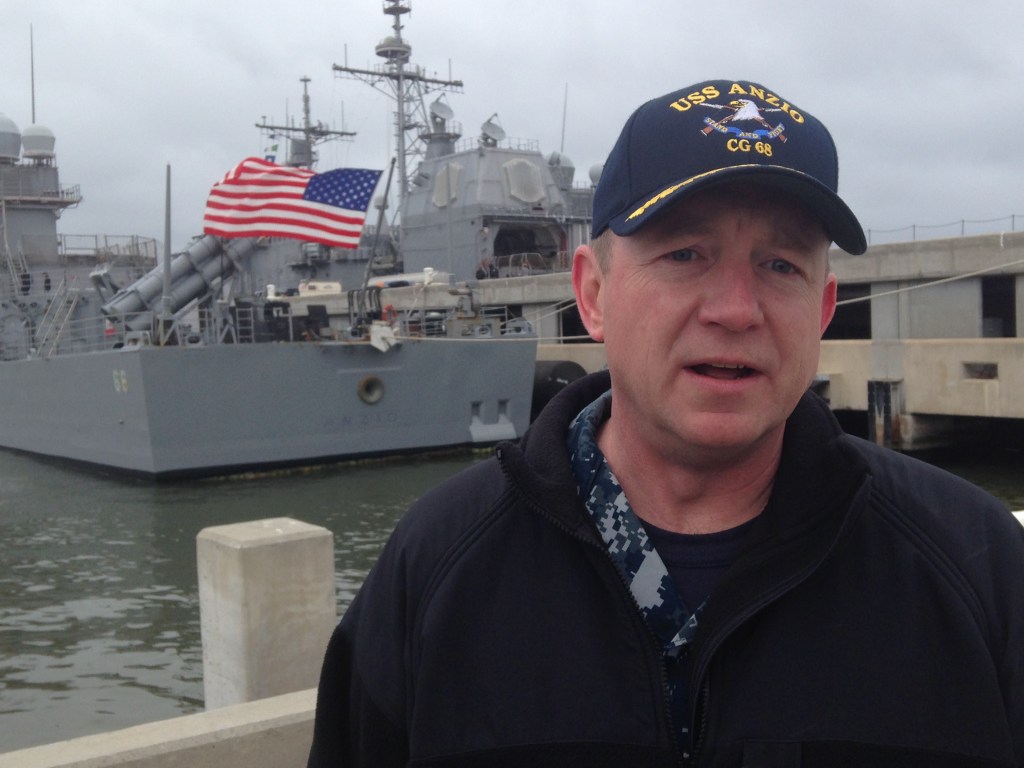
Roughly 60 percent of Anzio’s crew has turned over since Exercise Bold Alligator last year. Joint Warrior marks their first deployment and exercise of this magnitude, and is an “excellent opportunity” to hone their raw skills, said Capt. Brian Sorenson, the ship’s commanding officer.
Anzio and Porter will part ways when the exercise concludes, as the latter will proceed to Rota as part of the European Phased Adaptive Approach. The ship has “kind of a junior crew, so there is a little added stress,” said Cmdr. Blair Guy, Porter’s skipper. “Their first port visit will actually be a home port shift. But the crew is excited to get over there.”
Twelve families made the move to Spain ahead of the Porter. One was the family of Chief Damage Controlman (SW/AW) John Parks, an 18-year veteran on his eighth deployment.
“That transition has been outstanding,” he said. “It’s really due to the fleet family and wives clubs already in Spain. The sponsorship program is awesome, and made the process very easy.”
Parks said the younger crew has transitioned well from the yard to training, and they are confident they will hit the mark as they progress from exercise to operations. Porter’s crew of 23 officers, 24 chiefs, and 291 sailors will operate in continuous four-month patrols of European waters followed by four months of training, certification and maintenance. The BMD-capable Aegis ship will remain in the sustainment phase with training being conducted throughout the rotation.
“I think the four-and-four rotations are actually going to work out very well for us,” Guy said. “There is not a whole lot of gap in between patrols, so that means our operational proficiency will stay pretty high and the overhead for the crew will stay a little lower. So there won’t be a bathtub effect anymore,” where readiness levels drop post-deployment.
Four ships will be homeported in Rota by year’s end, and the Aegis Ashore system will be deployed to Romania. The destroyers Ross and Donald Cook arrived in fiscal 2014, and the destroyer Carney will head to Spain from its home port of Mayport, Florida, before October.
This is the first major deployment for the destroyer Porter since it collided with the Japanese-owned tanker Otowasan near the Strait of Hormuz on Aug. 12, 2012. No one was injured, but the impact tore open the destroyer’s starboard side. The repairs cost more than over $50 million. Repairs took seven weeks at the Jebel Ali port in Dubai, and cost $700,000. The skipper, Cmdr. Martin Arriola, was relieved of command on Aug. 30 and later received a letter of reprimand.