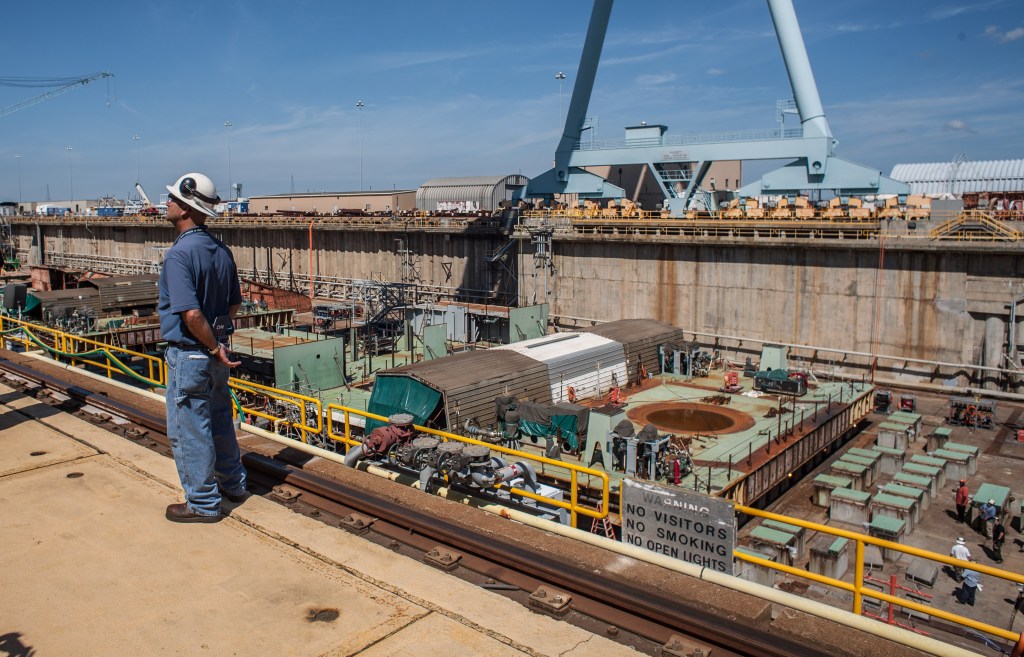
The futurenew carrier John F. Kennedy’s keel was barely laid before it found itself in its first battle. The second-in-class supercarrier is slated to cost just under $12 billion. The Navy wants to build one of these every five years, but an influential lawmaker wants the service to arrange a block-buy that saves money per ship and may allow the service to purchase more ships. found itself in its first battle before its keel was even laid in dry dock. This battle centers on the budget. JFK is slated to come in $1.6 billion less than the first-of-class Gerald R. Ford. The big question for the navy and Congress alike is how many carriers will follow, and at what cost.
Rep. Randy Forbes, R-Va., used the keel-laying ceremony in August to call for more ships than the 308 currently sought by the Navy. He is pushing for something closer to 346 ships, and promised to rally other lawmakers, the support of the House Armed Service Committee, but said service leaders have to take the first step.
“We need the Navy to come in and do a realistic assessment of what they need,” said Forbes, a member of the House Armed Services Committee who leads a subcommittee that oversees the Navy and Marine Corps.
The Navy’s 2013 Force Structure Assessment calls for a 3068-ship fleet that includes 11 aircraft carriers, 88 surface combatants, 48 attack submarines, 12 ballistic missile submarines, 34 amphibs and 29 auxiliary ships. The Navy is on track to hit the 300-ship mark by the end of the decade.
“If we had a larger-than-308-ship Navy, would that be a benefit in terms of doing our missions? Certainly,” said Sean Stackley, assistant Navy secretary of the Navy for research, development, and acquisition. “But the issue as always is going to be balancing the size of the fleet and the affordability of the fleet.”
On whether a fleet of 308-ship fleet is too low, Stackley said, “I am not the requirements guy.” He added: But he added that “We hope that the debate will continue [to ensure] whatever is determined to be the size of our Navy, that it is backed by the necessary resources to get there.”
That is the catch. While more ships would, for many, mean shorter deployments on newer vessels — almost a luxury cruise for sailors who have pulled 10 months on aging war machines — no one seems to agree on how to pay for those ships. If the costs are too high, or too many added costs getare tacked on, the program will get canceled. Yet A proven way to cut cost is not getting a thumbs-up from all members of Congress.
Some advocates seek A growing advocacy seek a return to the Reagan-era ship building model. In this scenario, Congress would put a large amount of cash up front to buy material in bulk, and thus at a better price (the common analogy is unit cost at a warehouse store such as Costco). The savings from this “block buy” would then be used to fund extra ships.
Though it is a common strategy for multiple aircraft programs, materials for carriers have not been bought in this manner since the 1980s, when where it was done with much success, said Bryan Clark, a senior fellow at the Center for Strategic and Budgetary Assessments who previously served as special assistant to the chief of naval operations and director of his Commander’s Action Group. Instead of covering the carrier’s $12 billion price tag over five years (as is done today), Congress consolidated much of the budget and essentially paid for each carrier in two years. That consumed a large chunk of the shipbuilding budget, which meant a reduction in the purchase of other ships. But the Navy would buy large numbers of surface ships or submarines in subsequent years to balance things out. It still took years to build the ships, but paying for them up front gave shipyards more buying power.
That was then. Making such a sell is quite different today.
“Would there be savings? Absolutely,” Stackley said. But block buy “is a difficult business case.” That’s because some lawmakers don’t like to commit a future Congress to continuing to fund something a previous Congress had started, as is the nature of the multiyear procurement, Stackley said. It’s also viewed as impractical for carrier construction. These hulking ships take years to build and typically feature design updates between hulls to accommodate new systems that render some of block-buying moot.
The Senate and House armed service defense committees would likely support a block buy, as would the Senate Appropriations Committee, Clark said. The House Appropriations Committee has traditionally not been a fan. In addition, some Pentagon leaders have been wary of big investments for future weaponry when future needs are ever-changing. They would rather go slow and steady than endure cost overruns and questionable procurements, especially after the beating every service branch has taken in this category over the past decade. But that pace will likely mean fewer ships at higher costs.
Simply put, a larger Navy will demand a different acquisition strategy.
“We’ve got to bring back more predictability into what we are doing,” said Forbes, who chairs the HASC Seapower subcommittee. “You can’t have the best purchase power if you are constantly up and down, starting and stopping. Acquiring material in bulk, in advance gives us a great opportunity to keep those costs down and keep the number of ships up.”