The outlook for sailors interested in off-duty education remains bright — Tuition Assistance will pay for 16 credits per year.Off duty college education is alive and well in the Navy – and fully funded 16 credit per year maximum.
The service has boosted the pool of TA money for the current fiscal year up to $89 million, funds that are available so long as sailors complete the application process. The only caveat is that you’ll have to do well: sailors who get D‘s or flunk courses will need to repay the tuition cost to the government. The service is also budgeting $9 million for courses at sea under the Navy College Programmed for Afloat College Education (NCPACE)program.
That’s the good news as officials also say they’re happy with the tuition assistance program and the current “business rules” governing who can use the funds and when. They also say there’s no current plans to change any rules or policy, for now.
But by the end of this fiscal year the face of the Navy’s college programs — the 33 brick and mortar Navy College Offices on bases in the United States could be closed to help fund new fleet training.
But those cuts won’t impact funding for college courses, officials as dollars for credits are up this year.
Officials have budgeted $88.8 million for tuition assistance in fiscal 2016, a planned $2.2 million increase from $86.6 million spent in 2015.
But that’s not all, the Navy also plans to spend $9 million to fund college courses at sea under the Navy College Programed Afloat College Education program, too.
“We’ve had about 46,000 sailors in fiscal ’15 who took advantage of tuition assistance,” said Ernest D’ Antonio, head of Navy Voluntary Education programs. “Those sailors took roughly a total of 134,000 courses.”
What sailors students need to know about getting TA money and a proposed overhaul of the Navy College offices:
TA rules
According to official statistics provided by D’Antonio, 94.51 percent of those taking tuition assistance were enlisted sailors, the majority of whom were E-5s and E-6s. bulk of which, 53.89 percent fell into pay grades E-5 and E-6. Junior officers are primarily the rest of the TA users. Officers, on the other hand, make up only 5.49 percent of tuition assistance users. Within the officer ranks, 69.41 percent of officer users are in pay grades O-1 through through O-3, with those Lieutenants, a 49.36 percent lions share of users.
But To get a piece of the TA pie, sailors, more than any other military service, must navigate a set of business rules in order to get funding approved for their courses. Right now, the Navy fully funds 16 credits of school each fiscal year for each sailor. To qualify for that 100 percent tuition coverage, sailors must meet certain conditions.
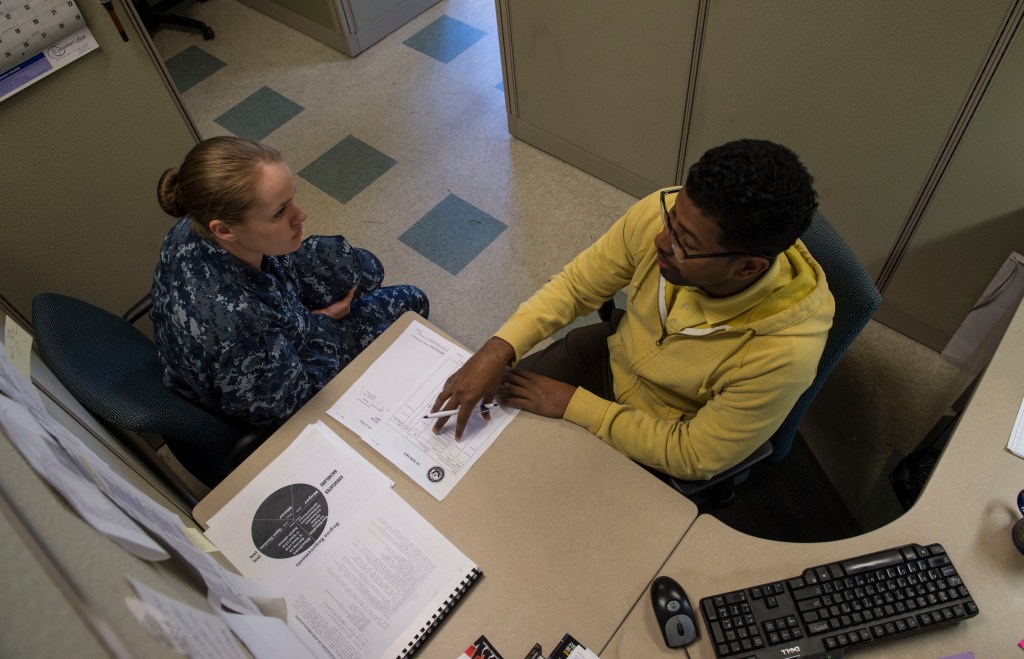
“Before a sailor’s can even begin to apply for tuition assistance, they have to have been counseled by a Navy voluntary education counselor and have a degree plan on file,” D’Antonio said.
This step, he said, ensures sailors are counseled and have settled on a degree that will meet their needs and that the institution is accredited and will give them maximum credit for their Navy skills and experience, too. Your command also plays a role.
, per sailors. Currently, there’s no plans to increase or decrease that maximum amount, either.
But the command plays an important part in the approval process, too.
“We rely on the commands to be the quality check and the final authority on whether this sailor is ready to take on college courses and that they meet all the eligibility requirements,” he said.
That’s because, Sailors are basically forbidden to take college courses during their first year at their first command to allow them time to get qualified in their rating and watchstanding positions. Commanding officers were granted the authority to waive that rule, however, in 2014. Sailors seeking TA dough must also be in fitness standards and stay out of trouble; disciplinary trouble can limit or bar sailors from participating.
But in 2014, officials gave CO’s the discretion to waive that rule if they are satisfied.
In addition, sailors out of fitness standards, or who have been in disciplinary trouble also could be limited or banned from using TA by their commands.
“So for those reasons, a sailor’s request must first get signed off on by their command before we’ll approve it,” he said.
Commands could also get involved again if a sailor fails to complete their courses with at least a “C” grade average, too. DoD’s more strict rules took effect affect in October. They require rules require any TA student with a grade below a “C” to repay the government the course tuition, out of pocket. falling below that to pay the mark to pay the government back.
The Navy’s TA rules have evolved over the past decade and have made the Navy’s TA program very efficient and cost-effective, D’Antonio said.
“We are always looking at ways to make the program better for sailors and more cost effective,” he said, though he also said there are no new rules or policy changes in the works at the moment.
“We are in a really good position right now because we have some solid TA business rules which sailors and commands have to follow,” D’Antonio said. “As we implement those rules, we’re very focused on trying to do as best [as we can] and what is right for the sailors and the Navy.” and really aren’t doing anything more than any parent might do in managing their children’s college education,” he said.
For example, he said, sailors can’t just sign up for TA and start taking courses until they’ve met certain conditions.
Navy College offices
The services and counseling that sailors seeking to use education benefits could change soon. And though the future looks good for funding off duty education credits, how sailors get help and counseling could change drastically at bases inside the United States starting in fiscal year 2017.
Plans are currently in the works to that would shutter nearly all of the 33 Navy College offices in the continental U.S. by October 2016, in favor of online and phone support. Navy College offices not only provide sailors with in person counseling and coordinate , they also coordinate college classes on many bases, too.
But Navy officials are trying to rework their enlisted training pipelines and over the next four years are planning to build up more robust training facilities near to the pier. Officials said they weren’t ready to discuss the plan that could be proposed for the fiscal year 2017 budget.
But though officials confirm the proposals are on the table, they say they can’t release the details because they involve future budget cycles.
“All [Program Objective Memorandum 2017] proposals are pre-decisional at this point and no final decisions have been made,” said Lt. Cmdr. Kate Meadows, spokeswoman for Naval Education and Training Command.
The Navy has already closed the Center for Personal and Professional Development in Dam Neck, Virginia, and has moved the Navy’s Voluntary Education Program office from Dam Neck to Pensacola, Florida. According to Ssources, said the plan will eliminate ources, the plan as of June was to eliminate 54 of the 80 Navy College counselor positions and close all but two or three of the Navy College offices in the U.S. This means, those sources say, that all but two or three of the service’s 33 Navy College offices in CONUS would close. Most likely, The remaining offices would likely be in the largest fleet areas, such as Norfolk and San Diego.
It would be the second round of office closings. cuts as In 2010, the service shuttered 15 Navy College offices at bases worldwide. The cuts, called a consolidation at the time, were necessary to fund the service’s Virtual Education Center, which helps sailors over the phone.
Since the Navy established the Virtual Education Center, customer traffic in the offices has dropped 47 percent, according to NETC data. Overall, there were 130,000 visits to Navy College offices in fiscal 2014. Officials estimate Officials tell Navy times that already 83 percent of sailors using Tuition Assistance are taking online courses and expect that getting their counseling and TA approval online shouldn’t be an inconvenience.distance education courses online. So for those sailors, officials say, going online for their counseling and TA approval won’t be an inconvenience at all.