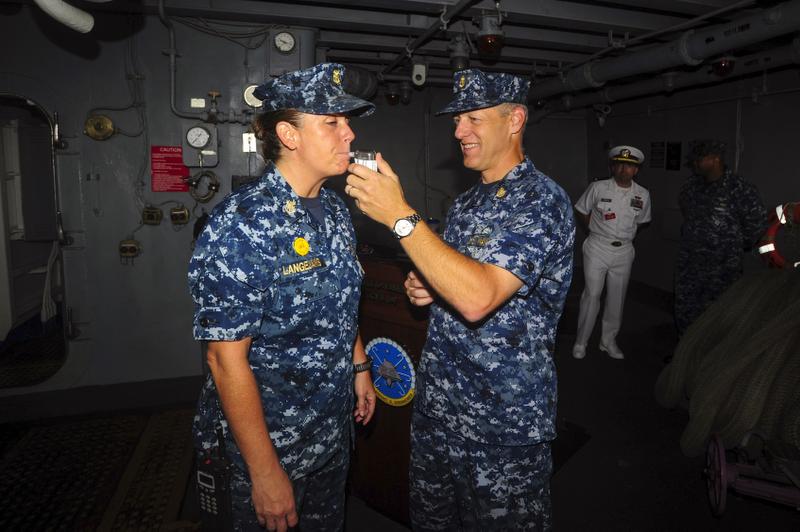
When Cmdr. Armando Ramirez arrived aboard his ship late one Saturday night, he was greeted by his command master chief administering a breath test, even though Ramirez was not on duty.
Less than a month later, in mid-September, Ramirez was removed from his post as executive officer of the cruiser Cowpens, after being found guilty at admiral’s mast of drunken driving and conduct unbecoming — charges for which the alcohol detection device provided part of the basis for further action. He had left the ship less than two hours after walking aboard, and a witness saw him get into his car and drive off, said an official with knowledge of the situation.
Ramirez’s high-profile reprimand is the latest evidence that devices initially billed as being solely for a sailor’s education and counseling can be used as a part of the disciplinary process, an ambiguous situation that one defense attorney called “a slippery slope.”
The alcohol detection device result played a central role in Ramirez’s firing. The command reported his blood-alcohol content as 0.119 in a “Navy blue” situation report that alerted the service’s leadership and used the finding as a basis to launch a command investigation.
After the voluntary breath test showed Ramirez was over the legal driving limit, the CMC suggested he stay on the ship. But Ramirez decided to leave less than two hours later.
Alcohol detection device results “are not to be used as the basis for disciplinary measures,” according to the Navy’s instruction. But they can be used to start or assist an investigation, said a defense attorney who reviewed the Navy’s rules.
“The instruction makes clear that it can be used as a basis for probable cause,” said former Air Force judge advocate Larry Youngner, using the term that gives officials authority to conduct searches when wrongdoing is suspected.
Youngner, an attorney at the firm Tully Rinckey in Arlington, Virginia, said the Navy can’t use the results as evidence in a judicial or non-judicial process, but that the burden of proof for charges in a non-judicial process is low enough that alcohol detection device results may not be needed to get a conviction.
‘A fine line’
The Navy began rolling out Breathalyzers at the end of 2012. When it was introduced, Navy leadership said it was an educational tool designed to prevent sailors from making decisions that could get them in trouble.
Navy Secretary Ray Mabus led the charge to get the program started as part of an aggressive effort to cut the number of alcohol-related incidents in the fleet.
“The way we see this is not as a punitive tool, but something to identify sailors with problems and get them to the appropriate counseling and treatment before this behavior results in serious, potentially service-disqualifying misconduct,” Mabus said in a March 2012 interview with Navy Times.
But the instruction allows for duty section leaders to pull sailors from the watch bill if they blow a 0.04 or greater — which can lead to disciplinary review boards or investigations.
“Legally speaking, it’s a bit of a slippery slope from the Navy’s perspective,” said Raymond Toney, a California-based lawyer who specializes in military law. “It’s a fine line to walk between having the knowledge of the [alcohol detection device] results and keeping them separate from the legal process.”
Toney said Cowpens was following the instruction by administering the breath test after the XO showed signs of intoxication.
“I think it should be said, more power to the command master chief for having done what he did,” he said. “It certainly took some courage to take the XO aside and intervene before he could do something dangerous. He should be commended for that.”
For sailors, the case is a reminder that while the results of the alcohol detection device may not be admissible as evidence, they certainly can lead to legal trouble, Toney said.