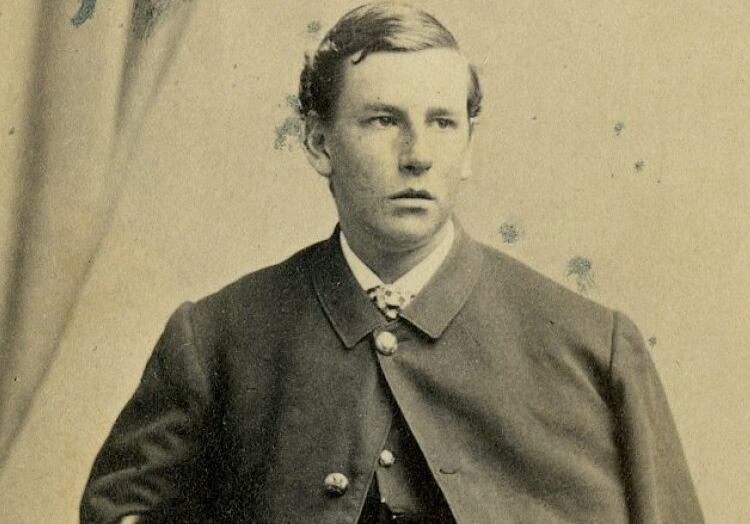
Charles Appleton Longfellow was the oldest child of American poet and writer Henry Wadsworth Longfellow.
A dramatized version of Charley’s story was recently made into the movie “I Heard the Bells,” but the true story behind the origins of the Christmastime poem-turned-song is just as, if not more, interesting.
Henry Wadsworth Longfellow vehemently objected to his son’s desire to enlist in the Union Army. But in 1863, at the age of 18, Charley ran away from home and enlisted in the 1st Massachusetts Artillery.
He informed his father of his decision in a letter mailed from Portland, Maine.
“I have tried hard to resist the temptation of going without your leave but I cannot any longer,” he wrote. “I feel it to be my first duty to do what I can for my country and I would willingly lay down my life for it if it would be of any good.”
Within two weeks of his arrival, likely because of his famous father’s connections, Longfellow was commissioned a 2nd Lieutenant in the 1st Massachusetts Cavalry.
On Nov. 27, 1863, while involved in a skirmish during a battle of the Mine Run Campaign, Charley was shot through the left shoulder. The bullet exited under his right shoulder blade and skimmed his spine.
The wound was considered grave, and the army surgeon told the elder Longfellow that “paralysis might ensue” for his son.
On Christmas day 1863, as his son recovered from his wounds, Henry penned the poem “I Heard the Bells on Christmas Day,” with many references to the Civil War.
The cannon thundered in the South
And with the sound
The carols drowned
Of peace on earth, good-will to men!
It was as if an earthquake rent
The hearth-stones of a continent,
And made forlorn
The households born
Of peace on earth, good-will to men!
And in despair I bowed my head;
“There is no peace on earth,” I said;
“For hate is strong,
And mocks the song
Of peace on earth, good-will to men!”
Then pealed the bells more loud and deep:
“God is not dead, nor doth He sleep;
The Wrong shall fail,
The Right prevail,
With peace on earth, good-will to men
— Henry Wadsworth Longfellow
Charley would survive his wounds, but did not return to the war.
He kept in touch with friends made during his brief career as a soldier, receiving letters and photographs from them and creating a scrapbook of newspaper articles relating to his unit’s role in the war.
He went on to become a world traveler and author.