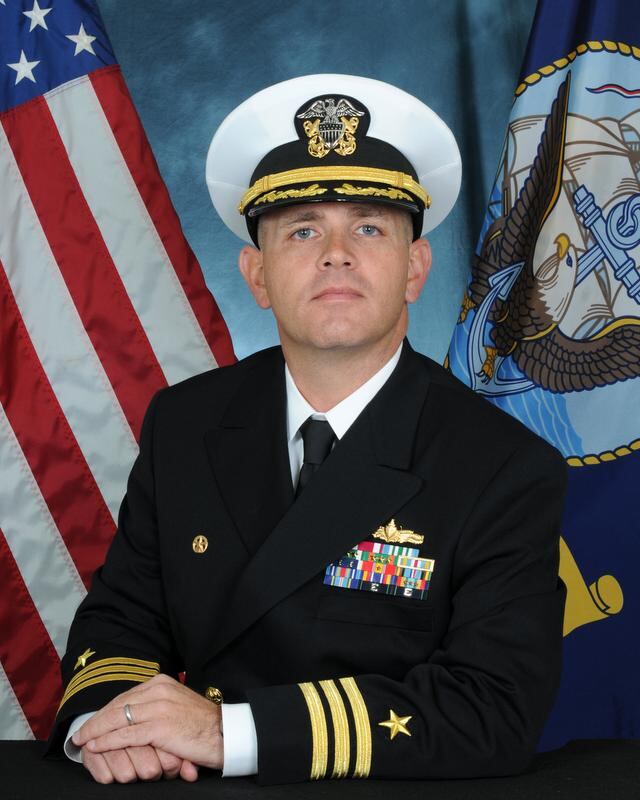
Cmdr. Joseph Fauth was deployed to the United Arab Emirates in February when his handling of a sex assault thousands of miles away undid his career.
Although the then-commanding officer of Coastal Riverine Squadron 3 was with the bulk of his squadron overseas, he was still overseeing the rear detachment back in the states. It was on a rear detachment mission that one of his chiefs allegedly raped one of his junior enlisted sailors, a situation that Fauth's bosses believe was preventable.
Fauth's chain of command contends he lied to his superiors during their inquiry into the alleged sex assault, according to a newly released report. Fauth was fired Aug. 12.
The chief who was the alleged perpetrator had been going through administrative reprimand for fraternization. So when Fauth called his boss, Capt. Chris Peterschmidt, to discuss the incident, Peterschmidt asked whether he had known that this chief was on the rear detachment mission to Ketchikan, Alaska, where the assault allegedly occurred.
Fauth said he hadn't — a statement found to be unlikely by the subsequent investigation.
In the military's legal system, a false statement isn't considered a lie if the one giving the statement didn't know it was a lie at the time.
"I know in my heart that I didn't make a false official statement," said Fauth, who has since retired from the service, in an Oct. 6 phone interview with Navy Times.
That was backed up by the investigating officer, who concluded that Fauth's initial reporting wasn't intentionally misleading.
"CDR Fauth made an honest mistake when he told CAPT Peterschmidt that he did not know [the chief] was on the mission to Ketchikan during their 16 July phone call," the investigator said in his July 31 report, which Navy Times obtained through the Freedom of Information Act.
But Peterschmidt and the head of Navy Expeditionary Combat Command disagreed, saying Fauth had enough time to correct the record once he realized he had given inaccurate information to the commodore.
"Neither on that day nor up to the minute of his relief, he never came back and corrected the record with me," Peterschmidt said in an Oct. 9 phone interview with Navy Times. "I have to have complete trust and confidence in the information that my commanding officers relay to me."
In his letter closing the investigation, Rear Adm. Frank Morneau overturned the investigator's finding and faulted Fauth for not correcting himself after he was found to be in error.
"Cmdr. Fauth never took affirmative steps to contact [Peterschmidt] to correct his 16 July 2014 statement, admit his mistake and fully acknowledge his personal awareness and consent to [the accused's] senior enlisted leadership assignment to [the mission]," Morneau wrote. "This failure of personal integrity by Cmdr. Fauth nullified any benefit of doubt I would otherwise extend to a commanding officer claiming to have ... honestly forgotten a fact in a conversation with his [immediate superior in charge]."
The relief comes at a time when the services are under intense scrutiny from Congress and the public for their handling of rapes and other sex crimes.
Earlier in the year, the CO of the dock landing ship Germantown was relieved after his command master chief was accused of sexual assault. Questions over the CO's handling of such cases led, in part, to his relief.
'Reasonably foreseeable'
The trouble for CRS-3 began in February when one of Fauth's chiefs was accused of sleeping with a first class petty officer. Fauth took the chief to mast, sent him back to the rear detachment and began the process to detach him for cause, according to the report.
But the process of getting the chief removed from the command moved slowly. Meanwhile, he continued to be put on command watch bills, including the July mission during which the alleged sexual assault occurred.
Fauth said he kept using the chief because, aside from the fraternization case which involved a consensual sexual relationship, he had performed well.
"I felt he could still contribute," Fauth said in the interview. In his DFC paperwork, Fauth noted that he thought the chief "had good years ahead of him" and that "outside of this incident, [the chief] has been nothing but a model sailor and leader."
A more practical concern also drove that decision: The chief was one of the few qualified coxswains in the rear detachment and he was the only coxswain available in July.
"It was either we sent him, or I would have had to go to my leadership and say, 'We can't do the mission,' " Fauth recalled.
During the Alaska mission, a night of drinking led to several junior enlisted personnel ending up in the chief's hotel room. After a 23-year-old E-3 discovered she'd misplaced her room key, the chief offered to have her stay in his room. The sailor fell asleep and woke up later as she was being sexually assaulted, according to a Navy message enclosed in the report.
The alleged assault is still under investigation and the chief has been sent on a temporary duty assignment, according to NECC spokeswoman Lt. Cmdr. Stephanie Murdock.
In his endorsement, Morneau said the sex assault was "reasonably foreseeable," and that Fauth and the other members of the riverine squadron's leadership placed their troops in danger by failing to act faster to remove the chief from the command.
The command "demonstrated a lack of foresight, an intolerable acceptance of risk and an irresponsible disregard for the safety and well-being of assigned CRS-3 personnel," Morneau said in his letter closing the investigation.
In addition to Fauth, the CRS-3 executive officer, Cmdr. Greg Meyer, received a letter of instruction and had his date of taking command delayed. And Command Master Chief Lee Wright also received an LOI, but was not removed from his position.
'A ceremony with a cake'
Fauth said that while he disagreed with Morneau's conclusions that he had lied or put his sailors in any foreseeable danger, he still respects them both.
"Ultimately if they determine that they have lost confidence in my ability to command, they have the authority to act," he said.
For Fauth, 42,who is on terminal leave, the two months since being fired has been a time of healing — he was about three weeks from retirement when he was fired.
Most hurtful, he said, was the suggestion in the NECC news release that he put his sailors in danger.
"The safety of my sailors was in the forefront of every decision that I made," he said. "Then seeing some of the Internet comments, because of the way the release was worded, it left a lot of room for interpretation.
"To see that kind of stuff written about you at the end of your career, it's hard. Usually at the end of your tour you get a ceremony with a cake — you get an end-of-tour award, things that acknowledge your 20-plus career of service."
He had a retirement party with his family, friends and shipmates, he said. Since then, Fauth said he's come to terms with the way he left the service.
"Overall, I've been pretty Zen about the whole thing," he said.
David B. Larter was the naval warfare reporter for Defense News.