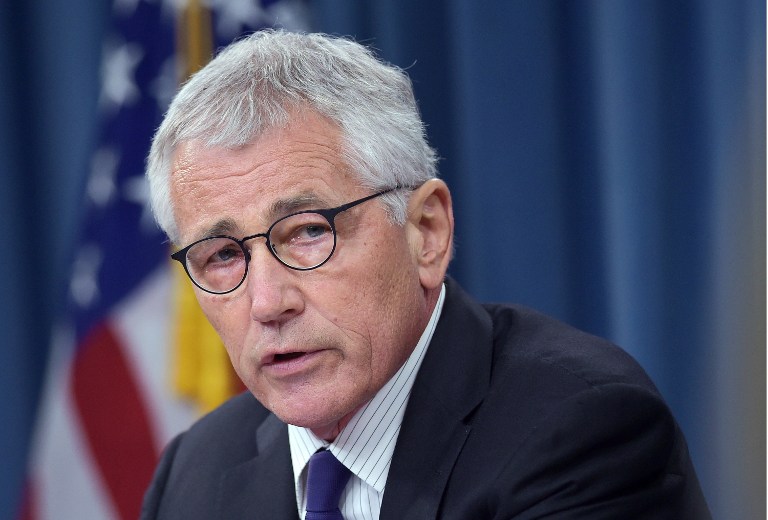
WASHINGTON – Defense Secretary Chuck Hagel on Thursday defended the Pentagon’s decision to isolate troops for 21 days after they return from Ebola duty in West Africa.
Hagel earlier this week signed off on the recommendation from the Joint Chiefs of Staff that goes beyond guidelines set by the Centers for Disease Control and Prevention. Isolating troops for 21 days even without symptoms of the disease, Hagel said, was a “smart, wise, prudent, disciplined, science-oriented decision.”
There are about 1,100 U.S. troops in West Africa helping to stop the Ebola virus, mostly in Liberia. The Pentagon may send as many as 3,900 troops. They are building treatment facilities and laboratories and training Liberian health care workers. U.S. forces are not expected to treat patients of the deadly virus, which has killed nearly 5,000 people in Africa.
Part of the reason to isolate troops is that they would be staying in the region longer than most medical workers, said Army Gen. Martin Dempsey, chairman of the Joint Chiefs of Staff. Troops are expected to have six-month deployments to disease-stricken areas.
Hagel and Dempsey also addressed the U.S.-led bombing campaign to roll back gains made by the Islamic State in Iraq and Syria, also known as ISIS or ISIL, which began on Aug. 8. The Pentagon has spent about $580 million there so far.
Iraqi and Kurdish forces have made some gains in recent days against ISIS fighters, Hagel said, but he cautioned that the fight will be “long and difficult.”
In Syria, Dempsey acknowledged that the mission to train and equip moderate opponents of Bashar Assad’s regime — a key part of the strategy — had not made much progress. Sites have been chosen to train the fighters, but nobody has been recruited or vetted, Dempsey said.