It’s been three years since the Defense Department lifted its ban against gays, lesbians and bisexuals serving openly in the military, but the services have little research on their experiences and needs or how the repeal of don’t ask, don’t tell has affected them, for better or worse.
For that reason, the Navy is launching a study to determine not only the psychological and emotional health of LGB members, but their experiences serving in the military, their identity, relationships and social support, their access to health care, and whether any lingering discrimination is an issue.
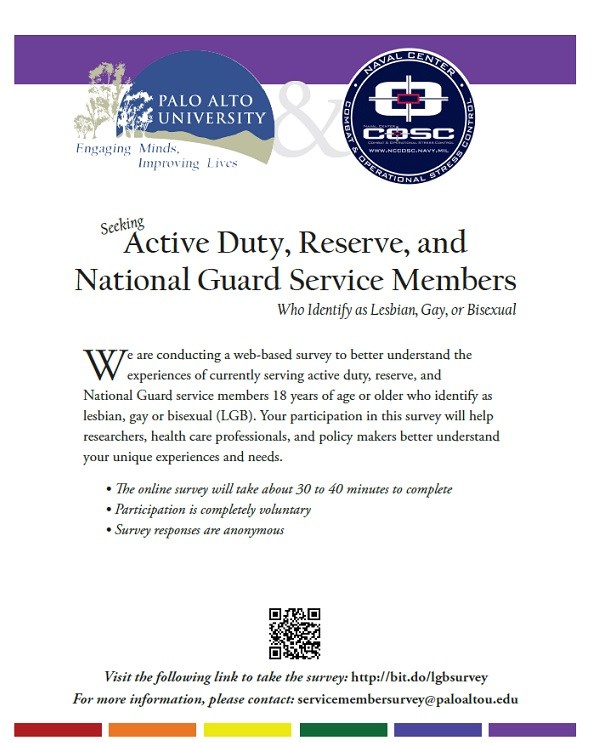
The Naval Center for Combat and Operational Stress Control has teamed with Palo Alto University in California to collect and interpret the new data.
“The repeal of this policy really implemented a culture change for the U.S. military and it’s incredibly important to comprehend how this shift is not just impacting our people, but also affecting readiness,” said Capt. Scott Johnson, NCCOSC director and a Navy medicine psychology expert, in a statement Wednesday.
To start things off, NCCOSC is looking to recruit about 400 active-duty, reserve and National Guard LGB service members to take an anonymous, web-based survey.
It’s imperative that the military understands the needs of LGB service members, and the survey will help support them, said Dr. Jagruti Bhakta, a NCCOSC research psychologist, in the statement.
“Results from this study will be made available to the public, including health care providers, civilian organizations, and the military community, to help educate and inform clinical practices, advance research and guide policy,” he added.
The survey takes 30 to 40 minutes to complete, according to the statement, and is available at http://www.nccosc.navy.mil/.