Chiefs' season is here.
With names of the chief petty officer selectees announced Aug. 4, the arduous mental and physical conditioning of these soon-to-be chiefs is about to start, and the Navy's top chief is demanding tough but professional training in the weeks ahead.
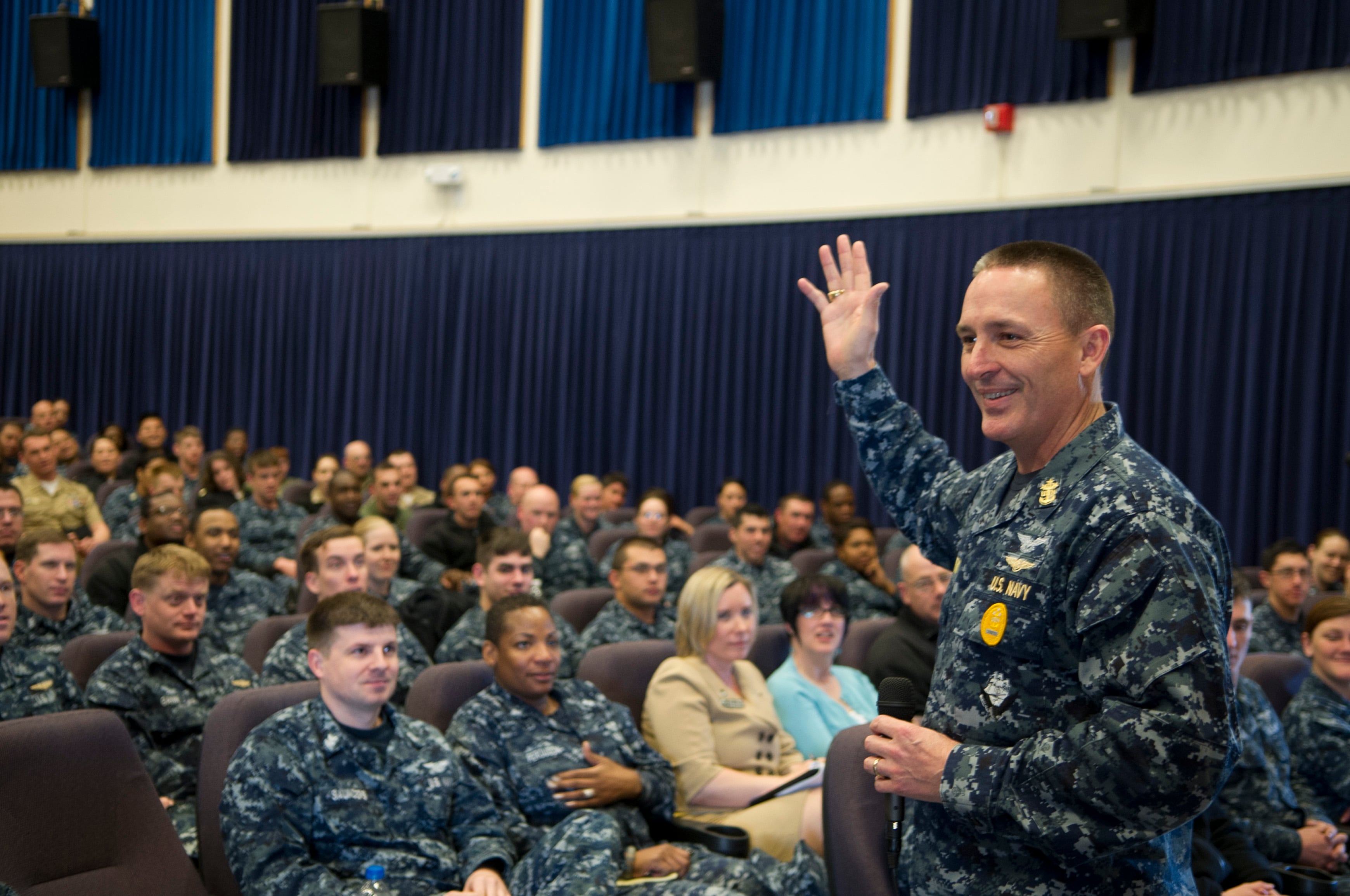
With the release of the names of this year's chief petty officer selects Aug. 4, chief's season is now upon us, Master Chief Petty Officer of the Navy (AW/NAC) Mike Stevens got ahead of the curve July 28 with a short message to his leadership mess about his expectations for this year.
Master Chief Petty Officer of the Navy (AW/NAC) Mike Stevens said this year's guidance for CPO-365 Phase II training, as chiefs' season is officially known, is essentially the same as last year. That word, intended to be passed down to all chief petty officers on the deckplates is simply, stay on course.
And because he's happy, overall, with the direction the Navy's CPO-365 Phase II training has taken the guidance is essentially the same as it was last year.
"My expectation is that Phase II will be challenging, difficult and even stressful at times, but I am confident that we can do this in a professional manner," Stevens said in an email to master chiefs overseeing the training. "As leaders, we have the responsibility to establish and maintain the conditions that provide all of our sailors with the opportunity to be successful, and we must do this while treating each other with dignity and respect."
This will be the third chiefs' season since Stevens ended the term "induction," and some of the more unsavory rites that went with it, in January 2013. As part of that, Stevens called for an end to shenanigans, saying the training leading up to the Navy-wide chief pinning on Sept. 16 must be tough but professional. It was a highly controversial move that dismayed many current and retired chiefs., during his first ear in office, Stevens took a bold step, but one he felt was already happening and "respectfully sundowned" the term "induction." With that announcement, he also called once and for all an end to "shenanigans" during the final push to Navy-wide chief petty officer pinning day on Sept. 16.
MCPON says it hasn't been easy, but says he feels good about how chiefs have embraced Looking back, he say it hasn’t been easy, but it’s been rewarding to see how the Navy’s CPO ranks have responded to this official new course and how they're embracing the new direction.
Stevens is the first to say that this course was started with the advent of the CPO-365 year-round training program started by then MCPON (SS/SW) Rick West. But as it evolved, his January, 2013 edict was already how most in the fleet were doing business. The goal, both MCPONs have said all along, isn’t to erase the past, but to move forward into a new era and a new way of doing business.
Each successive chiefs' season has had its incidents in the fleet, but Stevens says It’s not been without difficulty, either, nor has it ended all shennanigans, either. But though each successive year has still brought about questionable incidents in the fleet -- Stevens says they're on the decline and problems are being nipped in the bud by chief's on the ground.
Among the most dangerous occurred in 2013, when In 2013, Stevens' first year as MCPON, when 12 chief-selects were exercised to the point of exhaustion in Hawaii and were hospitalized after being instructed to do physical training to the point of exhaustion.
The resulting investigation concluded that miscommunication, not malicious intent, led to the grueling physical training. Four senior enlisted sailors were counseled afterwards. that the over training was a result of communications failures between those conducting the CPO-365 phase II training and found no malicious intent — still , four senior enlisted sailors were formally counseled in the wake of a grueling physical training session.
And last year, there were five allegations of abuses during the Phase II, which most in the Navy still call "chiefs' season," the time from the selectee announcement to the pinning. when the selectees are announced in the summer to their mid-September pinning.
They ranged from a chief select feeding a master chief on the carrier VijsonNone were of those, once investigated, was found to be abuse and none resulted in any disciplinary action, though necessary counseling was done where appropriate.
"What I'm most pleased about," Stevens told Navy Times in March, "it's something we don't often talk about, [but] every incident that occurred — and I believe we received five [this past year] — every one of them were stopped when the incident was occurring, stopped by a genuine chief who was a part of the training process and reported by that organization."
None of those incidents came to light from what he called "outside gotcha emails," as had happened frequently in years past. Instead Command master chiefs reported the incidents up the chief’s chain of command, as it was supposed to work, explaining what happened and what they were doing about it.
"I didn't have to get involved in any of it last year — the command stopped it — they recognized it and they took appropriate action, and I suspect that will continue to be the case until there [are]is no more cases," Stevens said.
Two and a half years ago, Stevens put a final period on the old days and ways of putting on chief's anchors in the first season after taking office. He says he took a lot of guff from former chief's, mainly retirees, but said he believed there was a better way to accomplish the same goal of providing petty officers a rite of passage as they put on their anchors and joined the mess.
"From what I've seen as I move around the Navy are incredible examples of creativity in putting tough and challenging training together," Stevens said. "I believe we are still providing that rite of passage that these sailors want and deserve, while keeping while still treating everyone with dignity."
Still, he’s not declaring victory and called on everyone involved to be on guard and stop unprofessional behavior things all chief’s involved with the Phase II process always be on the guard and to stop things before it gets out of hand. If training is to be tough and meaningful and at times stressful, he says it’s up to leaders to keep the big picture in mind to keep it safe and of course, dignified.
This year, unlike the last two, he chose not to make any significant changes to his CPO-365 and instead has been bringing a message of staying the course set and says the success of the Navy through the chief's mess depends on everyone playing together from the same sheet of music.
Too much change, he said is counterproductive.
"Our Navy trusts and follows the chief not because of rank or position, rather because of the reverence that has been earned through a legacy of excellence," Stevens said at the conclusion of his email message saying. "It is our charge to ensure we continue this legacy as we train and prepare our new chief petty officers."
"Please do not take this responsibility lightly."
Mark D. Faram is a former reporter for Navy Times. He was a senior writer covering personnel, cultural and historical issues. A nine-year active duty Navy veteran, Faram served from 1978 to 1987 as a Navy Diver and photographer.