The Marine Corps is maxed out on missions, and any more strain on the service would likely burn out the force and hurt Marine families, according to a new report released Wednesday.
With the Corps shrinking to 182,000 by 2017, the force will just barely be big enough to fulfill its current commitments and maintain a dwell ratio of seven 7 months deployed and 14 months at home. The Marine leaders have said a 2:1 deployment ratio is the bare minimum to avoid overworking the force and harming Marine families, and the author of a new report on the state of the Navy and Marine Corps agrees.
“In 2017, your available operating forces will just meet the requirement you need to support today’s presence levels,” said Bryan Clark, a retired Navy officer and analyst with the Center for Strategic and Budgetary Assessments, in a Tuesday presentation to reporters. “If you have any additional demand signals that come up, then you are going to shift some of the Marines to an operational footing that looks more like wartime.”
In his the report, Clark argues that both the Navy and Marine Corps and the Navy are nearing a tipping point. He argues that the sea services where they will either need either to increase end strengths grow or reduce their global commitments.
If the Marines had to deploy in large numbers in force — to fight the Islamic State group in Syria or even for stepped up security training and assistance missions in Iraq, — the deployment pressures would reach become critical levels. For some Marine communities units, Clark wrote, that is already a reality. already nearing a breaking point. , and already have for some units.
“If the Corps’ [operational tempo] were to suddenly rise because of a manpower-intensive contingency, the deploy-to-dwell ratio would fall to critically low levels,” Clark writes. “Even with a [present] total active force of 184,000, some high-demand units such as infantry battalions, MV-22 Osprey squadrons, and KC-130 tanker squadrons are currently experiencing [deployment-to-dwell]D2D ratios less than 1:2,” the report states.
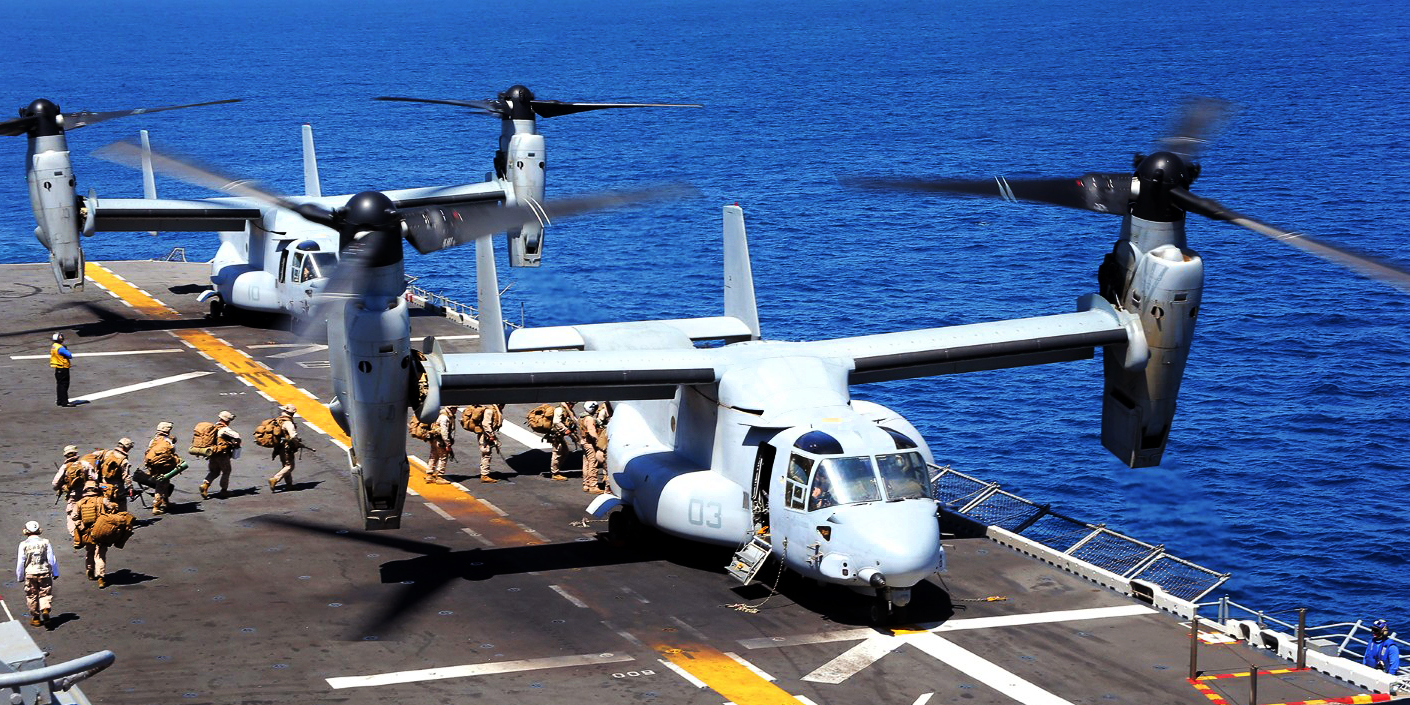
Marines with 1st Battalion, 4th Marines, board an MV-22B Osprey while at sea. A new report states that Osprey squadrons are in such demand that they’re not meeting desired deployment-to-dwell ratios.
Photo Credit: Sgt. Jennifer J. Pirante/Marine Corps
All this presupposes a 2:1 bare minimum. Marine Corps leaders have said that a 3:1 D2D ratio is ideal, but that would need to grow to 200,000 active duty.
“The operational pressure the forces is currently under raises serious questions about the long-term sustainability of the Marine Corp’s current rotational requirements,” Clark wrote.
Trouble on the high seas
The study also report argues With fewer ships,the strain on the Navy is an an inflection point as the fleet simultaneously grapples with tensions in the Asia-Pacific, renewed antagonism by Russian forces and the rising threat of the the so-called Islamic State group militants. mounting on sailors deployed around the world to respond to Sailors on sea duty are working harder than ever to fill the demand for forward presence while the fleet has shrunk over time.
A new report argues Congress either has to build a larger fleet or forward-base more ships to meet the surging demand for ships, squadrons and submarines, Clark argues. or released Wednesday claims the Navy is nearing a tipping point where it will either have to base more of its ships forward to fill the current demands,
Clark’s study shows that Over nearly two decades, the fleet has dropped from 333 ships to 272 ships, but the number of ships deployed at any one time has stayed steady at about 100 ships, according to the study.
“So if you just do simple math, that would indicate that each of the ships in the Navy is doing 20 percent more work and being deployed 20 percent more than its predecessors back in 1998,” Clark said in a roundtable with reporters to unveil the study. “The demand signal hasn’t dissipated, it has only gotten worse.”
[[I think we can cut this here for print.]]
The CSBA study, funded by the Navy League, is the latest in a series of warnings by experts who argue today’s 272-ship fleet is signal flares sent up by naval observers who say the Navy is becoming too small to prosecute missions around the globe, including handle it’s current tasking, which includes keeping twocarriers in the nderway in the Middle East and the Asia Pacific at all times, as well as fulfilling commitments in Europe, Africa and South America. Central Command, which is waging war on the Islamic State group, has been without a flattop since mid-October.
Clark’s data show that ships are spending about 25 percent more of their underway time deployed, meaning sailors are getting less underway time for training.
“On any given day in 1998, 62 percent of the underway ships were deployed, the rest were hanging around [the continental United States] doing training … the kinds of things that you use to gain proficiency,” Clark said. “In 2015, about 74 percent of the underway ships were deployed.
“What that equates to is that if you are underway and not deployed, you are on some rigorous schedule to get your [pre-deployment work-up] requirements completed. There isn’t a lot of time for additional exercises, additional training, steaming time for proficiency. A lot of that has fallen away as a result of the need to maintain 100 ships deployed with a fleet that has been continuously shrinking.”
Navy leaders also have also been concerned with the strain on sailors. The former chief of naval operations has said that the fleet is making progress on returning to seven and a half month cruises after years of deployments that ran to eight months and beyond. And the Navy has approved a new long deployment pay, known as Hardship Duty Pay-Tempo, that pays sailors up to $495 a month after being deployed straight for 220 days.
The stress of continued demands placed on a n ever-smaller fleet are already beginning to show, Clark said. The carrier Dwight D. Eisenhower sailed on back-to-back deployments, then had a unforeseen maintenance problems in the yards that forced fleet bosses to deploy the carrier Harry S. Truman in its stead.
Clark says the strain of long and erratic deployment plans could will ultimately lead to the kinds of maintenance and readiness issues the fleet is already beginning to see, Clark argues, and will ultimately lead to retention issues as the fleet gets burned out. All this means that leaders will either have to to accept more forward-baseing more of ships to cut transit times, buy a bigger Navy, or deploy fewer less ships around the world. accept a reduced presence level around the world because current funding projections and shipbuilding plans show that the Navy will only be getting smaller in the years to come.
“The Navy is going to have to accept reduced presence or do something to increase the amount of presence per ship,” Clark said. One suggestion option is to forward-base a second aircraft carrier in Japan, along with the carrier Ronald Reagan, a move that would cut weeks of transit time for West Coast ships headed to 7th and 5th Fleets.
The demands, on top of budget cuts that caused shipyard work stoppages, stress of the current workload, among other factors including budget cuts resulting shipyard work stoppages, has forced the Navy to extend deployments repeatedly for as long as 101 months. That in turn has caused wear and tear that threatens to cut ships’ service lives shorter, further reducing fleet size., which leaders say has caused more things to break on the ships and stripped each hull of service life — something that will inevitably lead to even more force structure cuts in the coming decades.
CSBA presented the report was presented to lawmakers and industry representatives at a Capitol Hill briefing Wednesday morning. at a brief on Capitol Hill Wednesday morning.