CANBERRA, Australia — A U.S. Navy commander warned Wednesday that if the United States lost access to international waters claimed by China in the South China Sea, it would have far-reaching implications beyond military.
U.S. Pacific Fleet commander Adm. Scott H. Swift told a conference on Indo-Pacific maritime security on Wednesday that sailing warships in freedom of navigation operations through contested areas where multiple countries have competing territorial claims was “not a naval issue.” He said the issue is the impact on the global economy and international law.
But he said that the United States has no expectation that such a loss of access would ever occur.
The U.S. Navy has angered China by sending warships close to artificial islands built by Beijing that include airstrips and radar stations. The U.S. lays no claims to the waters, but says it has an interest in ensuring freedom of navigation and overflight and peaceful resolution of ownership disputes.
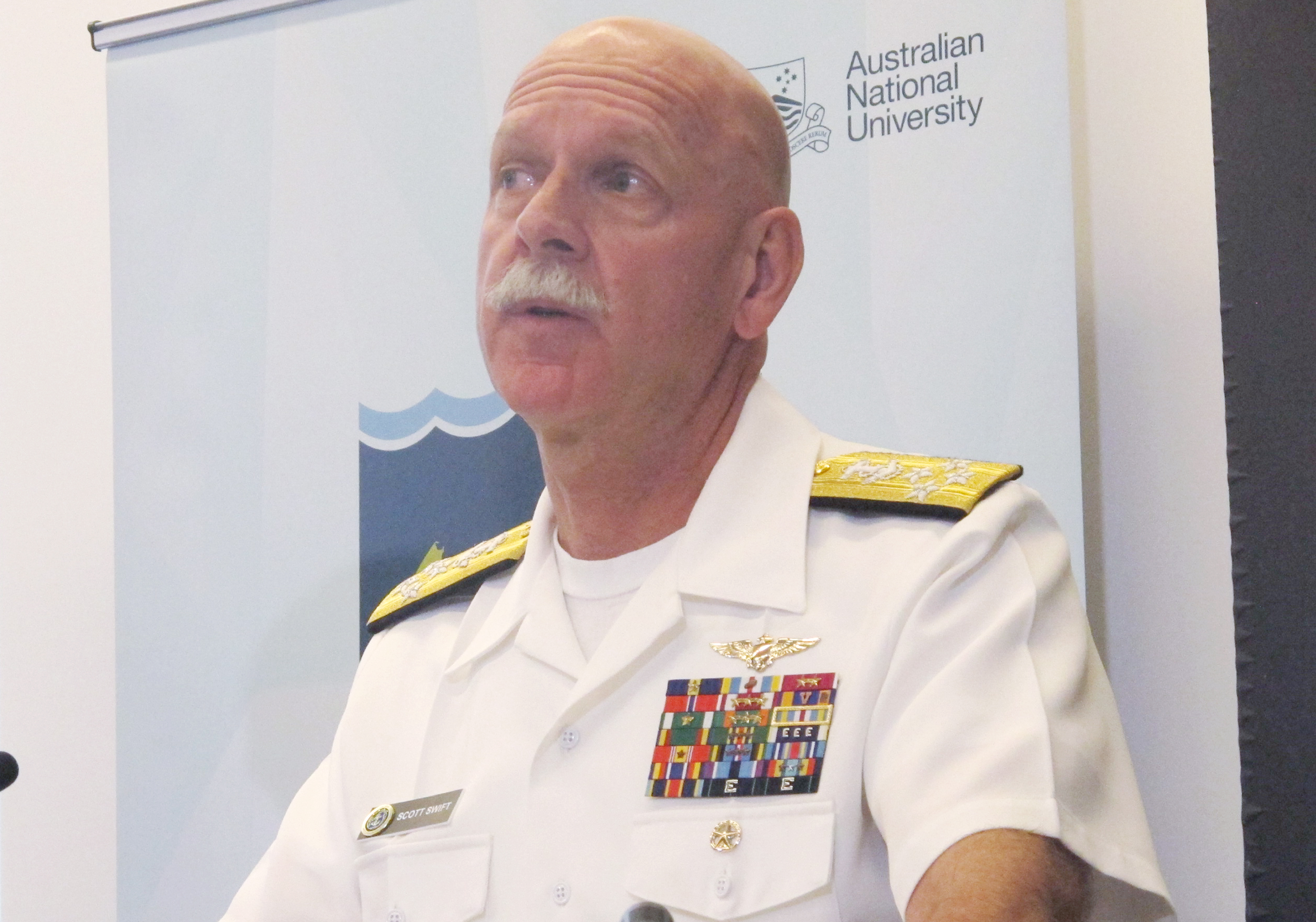
U.S. Pacific Fleet Commander Adm. Scott H. Swift addresses a conference on March 16, 2016, in Canberra, Australia. Swift said if the United States lost access to international waters claimed by China in the South China Sea, it would have far-reaching implications beyond military.
Photo Credit: Rod McGuirk/AP
Swift said there was a “palpable sense” that an attitude of “might makes right” was returning to the region after 70 years of security and stability since World War II.
While the United States was increasing its military presence in the region as part of its pivot to Asia, Swift said there was no need for more U.S. naval facilities in countries such as Australia.
“There’s no real necessity, in fact it become a facilities burden, if we were to expand in some other way. That’s not something that I would support,” Swift said.
Australia is increasing its defense ties with the United States, its most important strategic ally, as tensions and a military build-up mount in the South China Sea.
Copyright 2016 The Associated Press. All rights reserved. This material may not be published, broadcast, rewritten or redistributed.