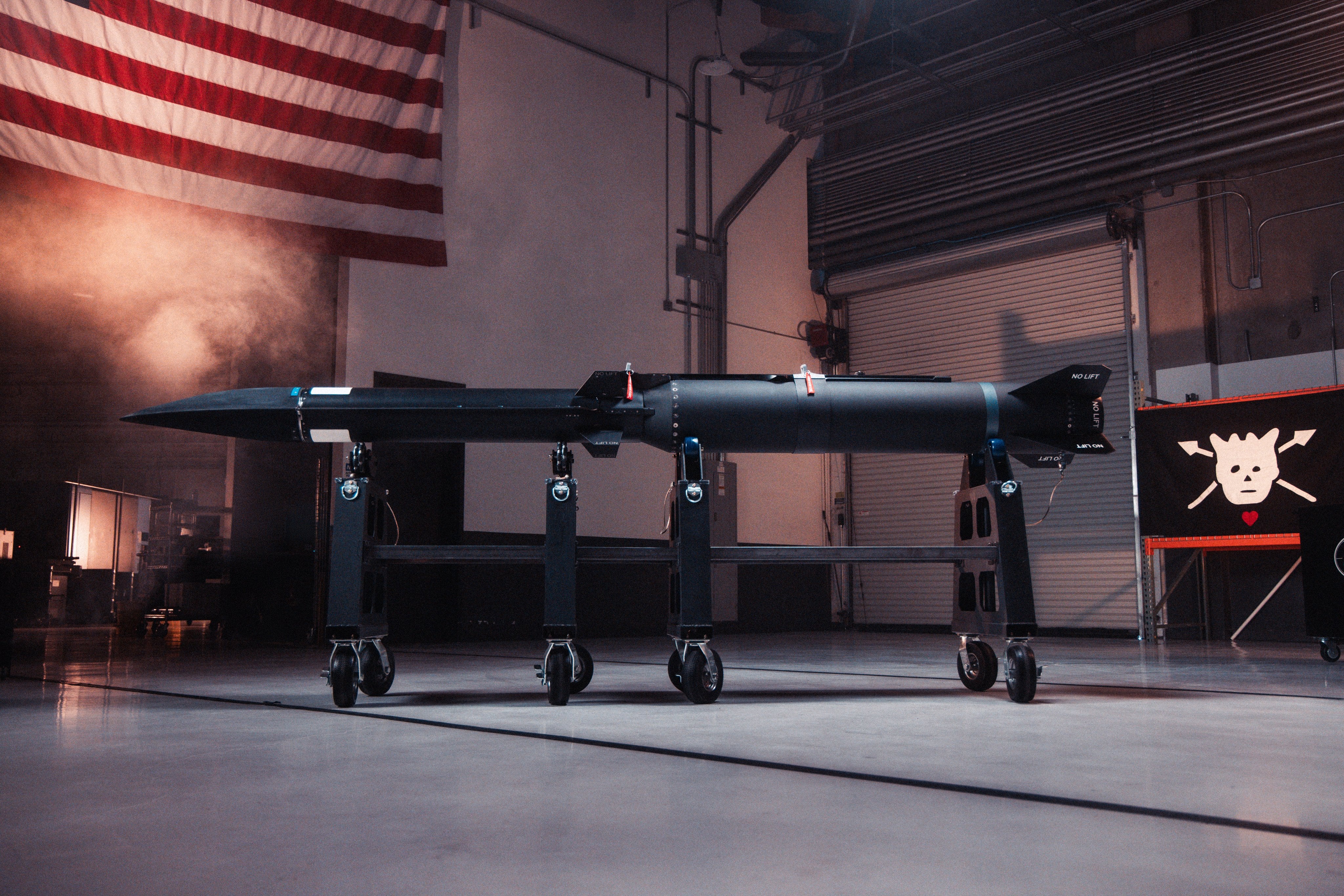
The U.S. Navy awarded defense startup Castelion $200 million for the production of its Blackbeard hypersonic missile, a low-cost, scalable weapon that can be fielded across carrier strike groups, the service announced Tuesday.
The Navy championed the contract as one of the first successful examples of the Department of the Navy Rapid Capabilities Office and how it “has adapted its acquisition structure to more rapidly meet the needs of the warfighter. … By leveraging advanced commercial manufacturing methods and a vertically integrated production line, this landmark program introduces immediate ‘affordable mass’ to the fleet.”
Blackbeard is “an air-launched, hypersonic strike weapon that provides carrier-based strike fighters with a responsive, long-range, high-speed strike option against maritime and land targets, enhancing survivability against advanced air defenses while significantly increasing magazine depth,” the release notes.
The missile, according to Inside Defense, is intended to serve as a standoff weapon with a 200-nautical-mile range, arming aircraft including the F-35 Joint Strike Fighter and the F/A-18/E/F Super Hornet.
The Navy has long sought an air-launched hypersonic anti-surface missile and, since 2021, has pursued an air-breathing hypersonic cruise missile through the program dubbed Hypersonic Air-Launched Offensive Anti-Surface Warfare, or HALO, according to earlier reporting from The War Zone.
In subsequent years, Raytheon and Lockheed Martin competed for the contract, with the Navy hoping to field HALO before 2030. However, the service scrapped the program in 2024, citing budgetary constraints.
Castelion is now offering the Navy a low-cost solution to its current gap in its weapons systems.
In February, the Navy awarded the defense startup nearly $50 million after it selected Blackbeard for its Multimission Affordable Capacity Effector (MACE) program. The Navy earmarked $156 million in its fiscal 2027 budget request to procure 353 MACE missiles. And in June, the Navy awarded the company $23.4 million for pre-production prototypes and 50 associated storage and shipping containers, according to Castelion.
The latest contract awarded to Castelion leverages the Small Business Innovation Development Act from the 2026 National Defense Authorization Act “to rapidly transition successful technology developed through private capital investment directly into production. This approach reduces millions of dollars in redundant, non-recurring engineering costs while introducing aggressive commercial competition into the munitions production ecosystem,” according to the release.
And with Castelion’s emphasis on low cost and producibility for Blackbeard, the Navy is seemingly positioning itself well in the post-HALO hypersonic missile world.
Claire Barrett is an editor and military history correspondent for Military Times. She is also a World War II researcher with an unparalleled affinity for Sir Winston Churchill and Michigan football.