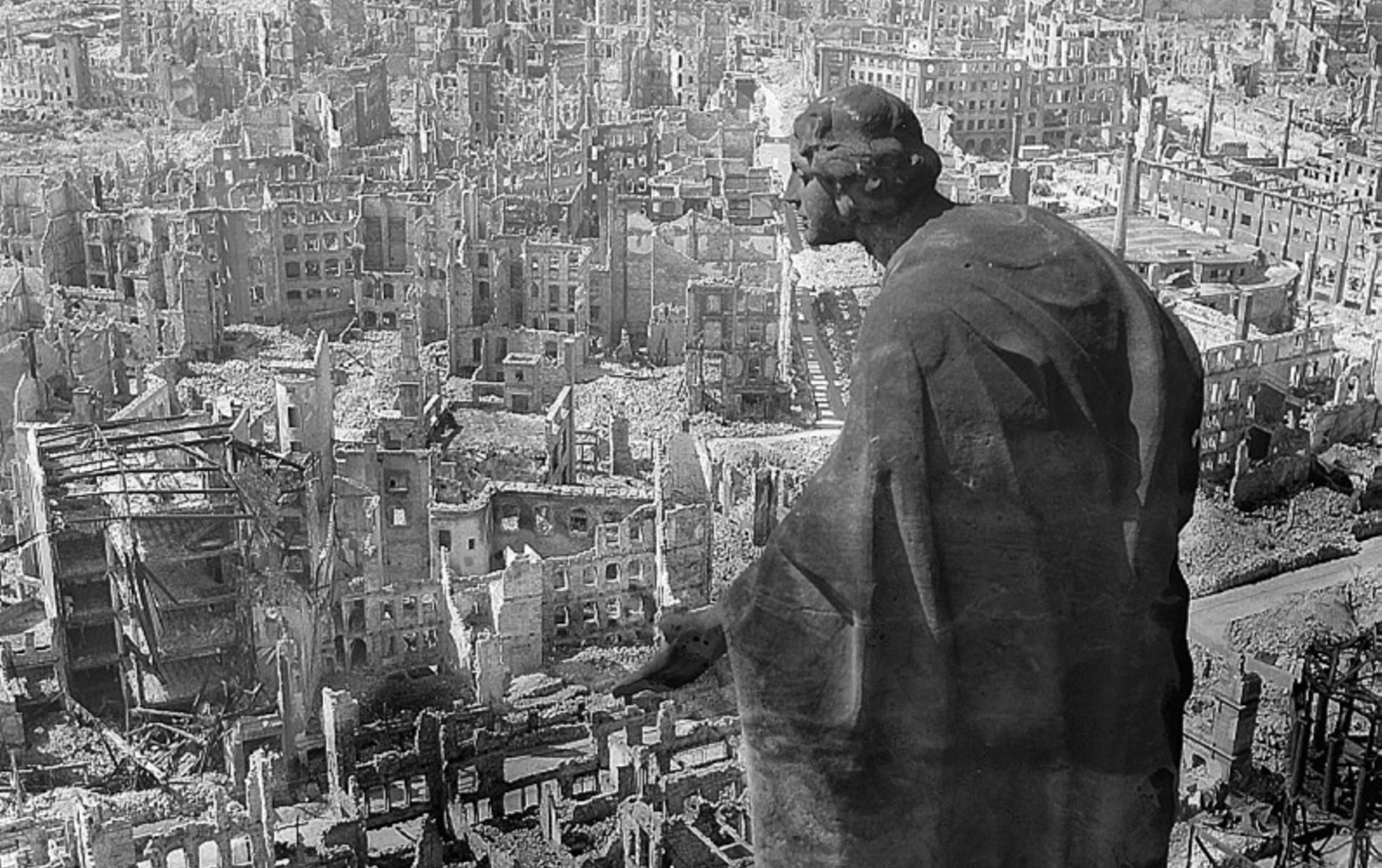
For 15 hours beginning on the night of Feb. 13, 1945, the historic city of Dresden, celebrated as the “German Florence” was battered by Allied warplanes.
Until that date, Germany’s seventh largest city with its 600,000 inhabitants — and roughly 700,000 refugees — had emerged from the Allied bombing campaign of World War II relatively unscathed.
The United States Army Air Force had bombed it twice — once in early October 1944 and again three months later, but even those attacks were considered relatively mild in comparison to the German cities of Berlin, Hamburg and Cologne, each of which had suffered repeated air raids throughout the war.
But in the wake of the Yalta Conference and as Soviet troops pushed deeper into eastern Germany, Allied focus began to concentrate on Dresden — in addition to its neighboring cities of Chemnitz and Leipzig — in the hopes of forcing capitulation.
The British were first to strike, as the Americans, while combating uncooperative weather, could not attack in tandem with their Anglo allies. That meant the British, under Air Marshal Arthur Harris, head of the RAF’s Bomber Command, would be the first to strike, according to the National World War II Museum.
Beginning at 10:15 p.m., unchallenged Lancaster bombers began to drop a deadly combination of high-explosive bombs and incendiaries on the city. Virtually unchallenged by either the Luftwaffe or antiaircraft guns, the low-level altitude of the bombers allowed for a careful, more precise lethality.
Within 15 minutes, 880 tons of bombs were unleashed on a city made of brick, sandstone and dry wood.
“The high-explosive weapons shattered windows, gouged out craters in the streets, and flattened walls. Firefighters were forced to take cover. The bombs also set in motion waves of high-pressure air,” according to the museum.
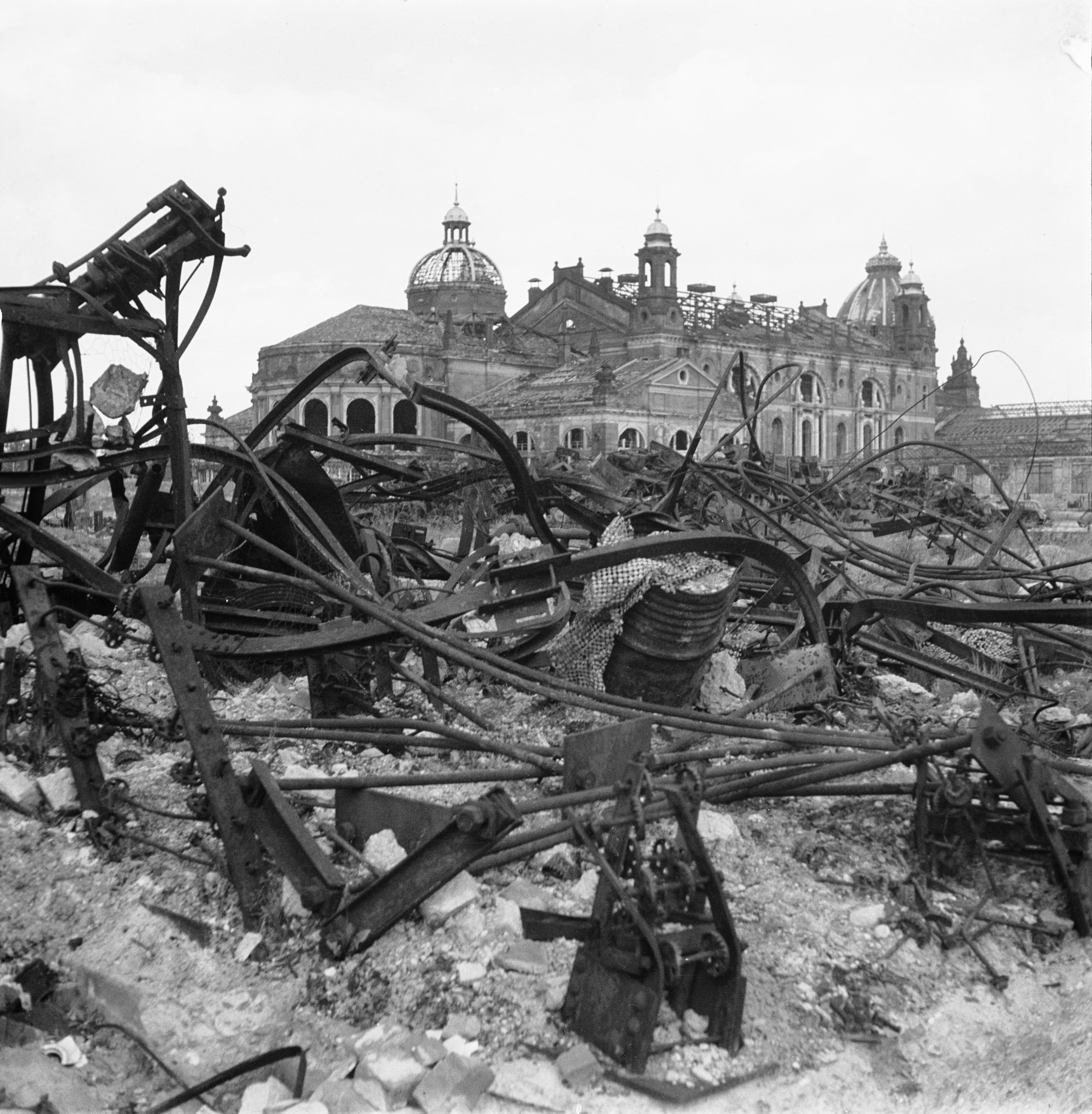
Small fires began to alight across the city center, soon amassing into a large, deadly conflagration.
“The thundering fire reminded me of the biblical catastrophes that I had heard about in my education in the humanities,” 18-year-old Götz Bergander would later write. “I was aghast. I can’t describe seeing this city burn in any other way. The color had changed as well. It was no longer pinkish-red. The fire had become a furious white and yellow, and the sky was just one massive mountain of cloud.”
As firefighters desperately battled the blaze, a second wave of British aircraft appeared on the horizon.
Made up of 550 heavy bombers — more than twice the size of the original formation — hell was once more unleaded.
“People’s shoes melted into the hot asphalt of the streets, and the fire moved so swiftly that many were reduced to atoms before they had time to remove their shoes,” writes historian Donald Miller in “Masters of the Air.”
“The fire melted iron and steel, turned stone into powder, and caused trees to explode from the heat of their own resin. People running from the fire could feel its heat through their backs, burning their lungs.”
The agony of the devastation also belied a chilling statistic: nearly 70% of the victims from the attack, according to Miller, suffocated from carbon monoxide poisoning.
Dresden resident Hans Schröter, whose ultimate fate remains unknown, wrote to his neighbor’s daughter on Aug. 5, 1945:
With the second attack, the door of #38 was destroyed, so that only the emergency exit for 40 and 42 was left. As we got to #40, the flames from the stairwell hit us in the face, so to save our lives we moved with haste… To get through the exit required great courage, which many could not seem to muster, and perhaps this was the case with your parents. They thought, perhaps, we would survive in the cellar, but didn’t factor in running out of oxygen. When I ran out, I saw my wife and son standing in Marienstrasse 42 so helplessly, but I had an older aunt from Liegnitz, and I wanted to save her, so I said to my wife, I’ll be back in 2 minutes. But when we came back in just that amount of time, my loved ones had disappeared, and I searched for them in the cellar, on the street — they were nowhere to be found. Everything was in flames, it wasn’t possible to get through, and since I couldn’t find my family, I summoned once more the little bit of courage that I had and went over to the Bismarck memorial and waited an hour across from the little house until the roof caved in. Then I went 30 meters along the Ringstrasse and waited there until daylight, and everything that you saw was so gruesome that you can’t describe it, everything was covered with burned corpses.
I went with great haste to my home and office, to find my loves still living, but that didn’t happen. They lay on the street in front of house 38, so peaceful, as if they slept.”
But for the residents of Dresden, Feb. 13 was just the beginning of the apocalyptic conditions.
At noon the following day more than 300 B-17 Flying Fortresses from the U.S. Eighth Air Force struck Dresden.
Battling through the haze of smoke still shooting 15,000 feet into the sky from the night prior, the Americans struck the city’s marshaling yard and, due to poor visibility, some still-reeling residential areas.
Erich Hampe, the general of technical troops who was sent from Berlin on the morning of Feb. 14 to reestablish rail communications, found the burnt-out area of Dresden utterly deserted save a llama which had escaped from the Dresden zoo, historian Richard Overy recounts in his book “The Bombers and the Bombed.”
Kurt Vonnegut and Gifford Doxsee, young infantrymen who had been captured two months earlier in the Battle of the Bulge, were part of a 150-POW labor detachment working in Dresden at the time of the bombings.
Vonnegut, who sheltered in a slaughterhouse with the address Schlachthof 5 (Slaughterhouse-Five), recounted the seminal event in a letter to his family.
“On about February 14th the Americans came over, followed by the R.A.F., their combined labors killed 250,000 people in 24 hours and destroyed all of Dresden — possibly the world’s most beautiful city. But not me.”
“The armada of U.S. Air Force planes pounded Dresden in the most intensive bombing of any single city anywhere in the world, ever, that night,” Doxsee wrote in an 18-page, single-spaced letter. “After the all-clear sounded, toward 3 a.m. on Wednesday morning, Feb. 14, 1945, our guards roused us again and forced us to climb back up to ground level. There we beheld another never-to-be-forgotten spectacle: the entire city of Dresden burning around us in all directions.”
For the third day and in a fourth raid, Dresden was hit. Originally sent to destroy an oil plant in the proximity of Leipzig, more than 200 American B-17s pivoted to their secondary target of Dresden after poor weather precluded the attack.
“The marshaling yards were not hit,” writes the museum. “The same could not be said about residential areas.”
By mid-March of that year, a Dresden police report counted 18,375 confirmed dead but estimated that figure to be much larger on account of an untold number of bodies simply liquifying from the earth. A 2004 historical commission set up by the mayor of Dresden estimated the final figure to be closer to 25,000 dead.
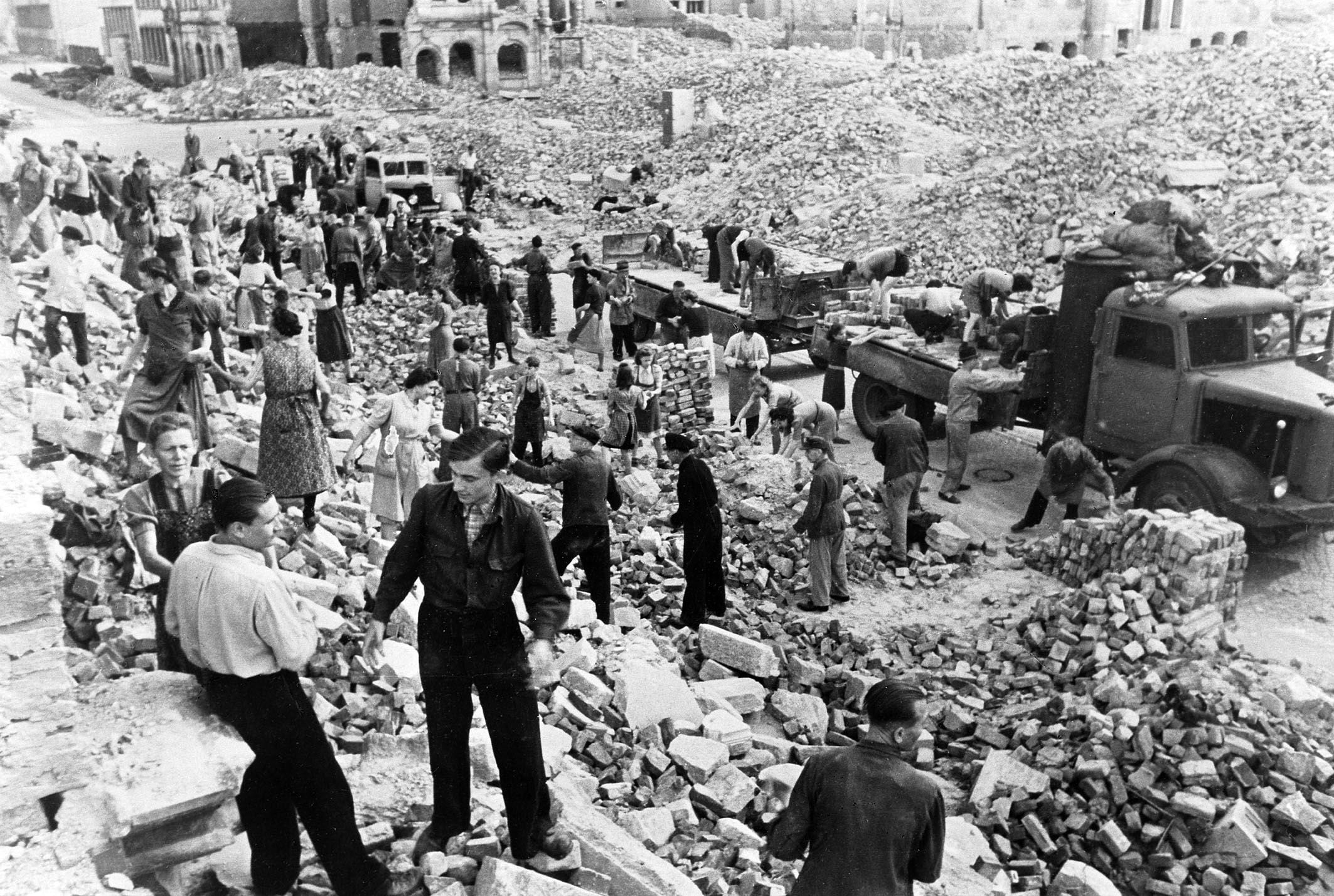
To avoid a health crisis, bodies that had not already been incinerated in the blasts were set in large pyres and burned.
Out of 220,000 homes in Dresden, 75,000 were totally destroyed and 18,500 severely damaged, according to Overy. Eighteen million cubic meters lay in rubble. Of the 600,000 inhabitants and an untold number of war refugees, only 369,000 remained.
Since the bombs first fell, significant controversy has arisen regarding the military necessity of the attack, with numerous postwar postmortem analyses. At the time, even British Prime Minister Winston Churchill questioned its morality.
In a letter to Air Marshal Charles Portal dated March 28, 1945, Churchill wrote: “It seems to me that the moment has come when the question of bombing of German cities simply for the sake of increasing the terror, though under other pretexts, should be reviewed.
“The destruction of Dresden remains a serious query against the conduct of Allied bombing.”
That hesitancy came perhaps too late, however, as the city was subjected to two further heavy aerial attacks by 406 B-17s on March 2 and by 580 B-17s on April 17, leaving an additional 453 dead.
Claire Barrett is an editor and military history correspondent for Military Times. She is also a World War II researcher with an unparalleled affinity for Sir Winston Churchill and Michigan football.