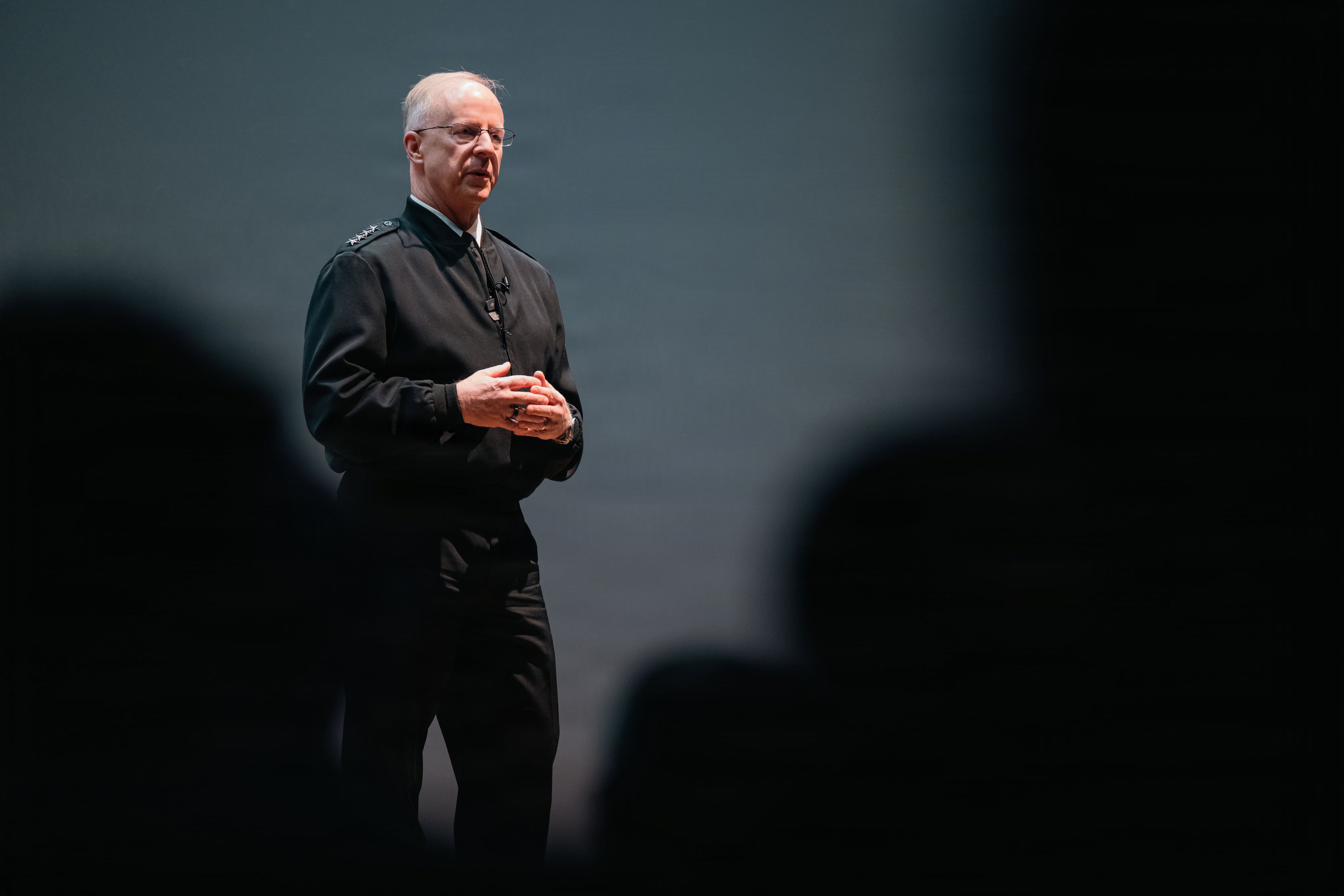
SAN DIEGO — The chief officer of the Navy sat down with reporters last week for a media roundtable to explain how his recently released warfighting instructions apply to the service’s rank and file and impact the implementation of autonomous systems.
Chief of Naval Operations Adm. Daryl Caudle expounded at WEST Conference in San Diego, California, on several aspects of his Feb. 9 directive, dubbed “Fighting Instructions,” which call on the service and its commanders to deploy smaller military assets to areas instead of larger aircraft carriers in order to provide more flexibility and speed to respond to conflicts, among other initiatives.
“I’m trying to write a document that’s enduring and lays out a framework that can be generally applied to how we think about the flow of generation and certification of naval forces,” Caudle told reporters Feb. 10.
Though the instructions address how commanders and leadership can help implement the new strategy, its success requires the totality of the service, including the service’s rank and file, to understand its goals and see how they fit in the “fabric” of the instructions, Caudle said during the roundtable.
The new thought process isn’t just for the big force package level; it also applies to the day-to-day operations of commands.
The instructions will help jumpstart conversations and solutions that trickle all the way down to the deck plate, the CNO said.
“Creating a smarter workforce is so vitally important to my strategy,” Caudle said. “That is the tide that raises every one of the problems I have.”
For instance, if a maintenance period is delayed by a day because of a broken part, it will require not just good project management, but also a resilient team that can figure out how to keep the project moving forward and keep people employed despite that hiccup.
RELATED
That requires sailors to be able to see where they fit in the scope of the entire project so they can problem solve accordingly.
It encourages an adaptive workforce, Caudle said, that knows how to do what’s needed without thinking so linearly in the way they accomplish their day-to-day duties.
The strategy is also about moving away from an all-or-nothing approach when it comes to deploying aircraft carriers, Caudle said.
Carriers like the USS Gerald R. Ford and the USS Abraham Lincoln have been routed away from the Mediterranean and South China Sea to the Caribbean Sea and the Middle East, respectively, in the last year.
The Ford assisted in efforts to remove then-Venezuelan President Nicolás Maduro earlier this year and the Lincoln arrived in the Middle East on Jan. 26, as the U.S. called on Iran to halt its nuclear program.
Further, Caudle wants to ensure that the Navy harnesses unmanned technologies in ways that allow combatant commanders and component commanders to solve operational problems.
“We don’t want [autonomous capabilities] just to be a gadget,” he said.
To harness unmanned systems effectively requires envisioning how those systems can be employed and assembled in ways that maximize their ability to be used, planned for, commanded and controlled and sustained in theater.
The Navy is arranged by domains, Caudle noted, including undersea, surface, aviation and cyber. Within each domain, there are subdivisions, typically arranged by preventive and corrective maintenance.
Currently, unmanned kits are also divided by these domains: unmanned underwater vehicles with the submarine force, unmanned surface vehicles with the surface force and unmanned aerial vehicles with aviation.
“But that’s not packaged because one of those capabilities generally is not sufficient to complete a complete mission set,” Caudle said. “So we have got to figure out how to build out these units of force so that they can be asked for in a logical way, and then command and control.”
He wants potential joint task force commanders for the systems alone who know how to command and control these packages of unmanned capabilities to achieve outcomes a strike group commander may want.
When asked how far along in the process the Navy is in making that goal a reality, Caudle said it had only been discussed in the last two weeks.
Riley Ceder is a reporter at Military Times, where he covers breaking news, criminal justice, investigations, and cyber. He previously worked as an investigative practicum student at The Washington Post, where he contributed to the Abused by the Badge investigation.